
Strategic Decision-Making for Pharma Facilities Before Engineering
March 20, 2026
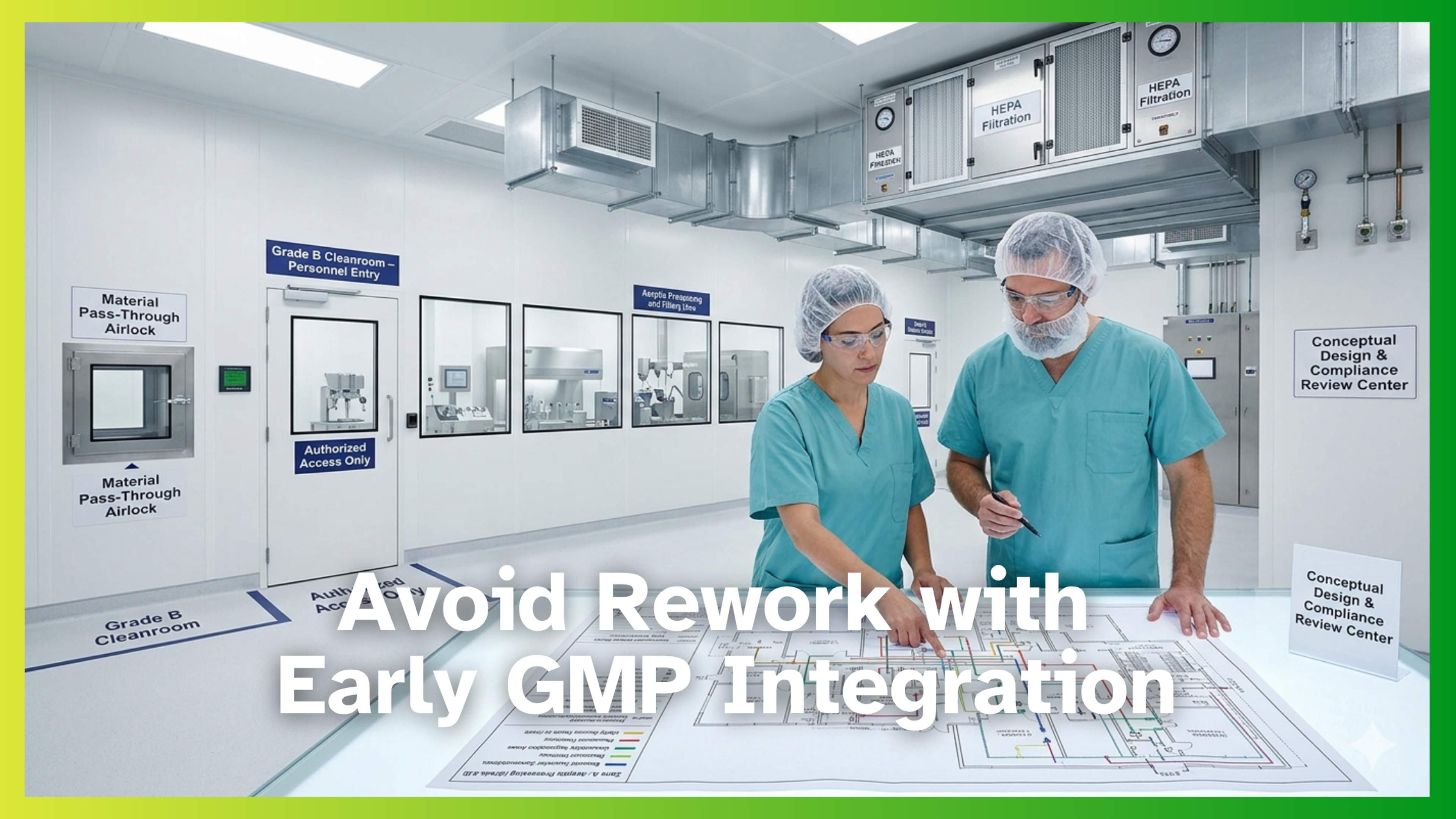
Inspection-Ready Pharma Facilities: Strategic Decisions Before Engineering Begins
What happens when your facility is technically well-engineered, commercially funded, and operationally on track, yet the core decisions behind segregation, validation, and contamination control still fail to stand up to regulatory scrutiny? For senior stakeholders and CXO-level decision-makers, that is not just a project issue. It becomes a capital-risk issue. For project and engineering leads, it means late redesign, compromised execution, and a concept that continues to evolve despite assumed alignment. For QA heads and quality directors, it means inheriting compliance exposure created before quality was ever given a fair chance to shape the facility logic. By that stage, the problem is no longer technical. It becomes a business-critical failure of early judgment.
This is exactly where the article goes next: the regulatory frameworks, validation decisions, contamination-control logic, and facility-planning choices that shape inspection outcomes long before engineering begins. From cleanroom strategy to utility intent and documentation traceability, the critical decisions are set far earlier than most projects acknowledge.
Why GMP Inspection Outcomes Are Determined at the Facility Strategy Stage
GMP inspection outcomes are determined before the design freeze because regulators assess whether the facility logic is robust, not whether the building is merely well-executed. Most observations are seeded when ICH validation principles, EU-GMP contamination-control expectations, FDA inspection-readiness logic, and known GMP observation patterns are not translated into concept-stage decisions on segregation, cleanroom classification basis, utility criticality, documentation traceability, and how the pharmaceutical plant layout will actually operate. These decisions originate in conceptual planning and become irreversible once the design freeze is in place.
Interpreting Regulatory Expectations Before Facility Planning
For experienced teams, the issue is not whether regulations matter, but whether they are interpreted with enough precision before the basis of design is frozen. A cleanroom in the pharmaceutical industry rarely fails because GMP was ignored in principle; it fails because concept-stage assumptions about classification boundaries, intervention patterns, pressure-cascade logic, containment, cleanability, and utility qualification were never rigorously resolved.
That is where senior judgment matters. GMP contamination control is not satisfied by room classes and airlocks alone; it requires a control model linking process exposure, material transfer, cleaning boundaries, environmental monitoring intent, and HVAC zoning. Regulators do not challenge the drawing set itself. They challenge the rationale beneath it: why areas are classified as they are, why flows cross, why utilities are deemed critical, and whether those decisions were documented before inspection pressure exposed them.
Translating Process Validation ICH Guidelines into Facility Strategy
The real value of process validation ICH guidelines in early planning is not conceptual alignment at a high level; it is forcing the organization to convert Stage 1 process knowledge into fixed facility criteria before the design becomes expensive to change. Stage 1 should already be shaping area pressure philosophy, equipment train adjacency, utility redundancy, process-transfer method, clean hold assumptions, environmental set-point discipline, and the recoverability of operations after intervention or deviation. When that translation does not happen, the site enters qualification with a layout that may be constructible but not operationally defensible.
- Stage 1 Process Design implications for facility concept
Stage 1 must lock facility constraints: containment mode, intervention frequency, transfer philosophy, and clean-hold limits. These define zoning, adjacencies, and environmental control. If unresolved, layouts remain buildable but fail under CQV and routine GMP stress. - Process capability and equipment sizing decisions
Sizing decisions drive CIP/SIP effectiveness, utility diversity, maintenance access, and sampling representativeness. Mis-sizing distorts flow and increases intervention. Define spatial envelopes, load cases, and maintenance zones before layout lock-in. - Validation Lifecycle Integration with Facility Planning
Facility logic must support IQ/OQ/PQ and continued verification without workaround. Sampling points, calibration access, system boundaries, and worst-case positions are concept-stage decisions. If not, validation exposes non-representative testing and weak traceability.
Using the GMP Inspection Checklist to Guide Facility Logic
A serious GMP inspection checklist is not a late-stage readiness tool; it is a way of stress-testing facility logic while strategic choices are still reversible. The point is not to rehearse likely questions. The point is to identify where the concept would fail under regulator-style scrutiny of rationale, traceability, and control effectiveness.
- Inspection observation patterns linked to facility planning gaps:
Recurrent findings stem from early errors: classification before exposure mapping, segregation without a cleaning logic, utilities defined without lifecycle validation alignment, monitoring added post-freeze, and flows optimized for operational convenience rather than compliance. - Documentation expectations influencing facility logic: Document decisions when made: zoning rationale, system criticality, accepted risks, and linkage to CQV. A validation master plan perspective should define scope, criticality, and evidence architecture—not be assembled later.
- Inspection traceability of facility decisions:
Traceability must connect risk assessment → zoning → HVAC segmentation → monitoring → qualification. Weak chains read as hindsight under inspection.
Common Inspection Observations Linked to Early Planning Errors
Findings framed during CQV typically originate in concept: inadequate segregation, unresolved contamination pathways, misaligned validation assumptions, weak sampling logic, and unjustified equipment placement. Engineering cannot resolve strategic ambiguity. If flows for people, materials, waste, and air are not decided early, installation qualification in pharma becomes slow, fragmented, and difficult to defend.
Early Contamination Control Decisions That Influence Inspection Outcomes
- Contamination Control Philosophy definition: Define dominant risks (microbial, particulate, cross-product, operator-driven) and the control model that addresses them. This sets the facility’s control narrative.
- Process Segregation Requirements: Base segregation on potency, exposure, sensitization, and cleaning limits. Decide spatial vs procedural vs closed/contained approaches upfront.
- Regulatory-driven Facility Classification Strategy: Classify based on exposure and intervention, not habit. This fixes HVAC architecture, pressure cascades, finishes, and monitoring scope.
Documenting Facility Logic for Inspection Readiness
- Why Inspectors Evaluate Decision Rationale: Inspectors assess intent and evidence. Undocumented decisions are indefensible decisions.
- Documentation Structures That Support Inspection Readiness: Maintain decision records, flow narratives, contamination risk assessments, system criticality registers, and validation scope links to create a continuous evidence chain.
Design-Related GMP Observations Seen in FDA 483s and EU-GMP Inspections
A large share of findings in pharmaceutical factory design reflects a misaligned concept, not poor installation: weak segregation, inconsistent contamination control, unclear monitoring logic, and validation programmes that cannot demonstrate control.
Common FDA 483 Observations Linked to Facility Design Decisions
In pharmaceutical plant layout design, typical observations include:
- Inadequate material and personnel segregation
- Weak contamination-control model
- Incomplete environmental monitoring design
- Utilities are not aligned with lifecycle validation requirements
These point to an undefined control state at the concept stage.
GMP Inspection Findings Related to Facility Planning
For GMP facility design, frequent findings include:
- Misapplied cleanroom classification
- Zoning gaps create cross-contamination risk
- Insufficient containment for potent products
- Incomplete contamination-control documentation
Late correction impacts multiple layers—layout, HVAC, procedures, and monitoring.
Why These Observations Originate during Conceptual Planning
Teams enter engineering without resolving EU-GMP Annex 1 expectations, cross-functional validation assumptions, and inspection evidence strategy. The layout then answers space needs, not control requirements.
Strategic Governance Decisions Before Pharmaceutical Facility Design
Executive decisions set the compliance burden. An FDA inspection readiness checklist is effective only when leadership defines product scope, markets, technology, and risk posture before design.
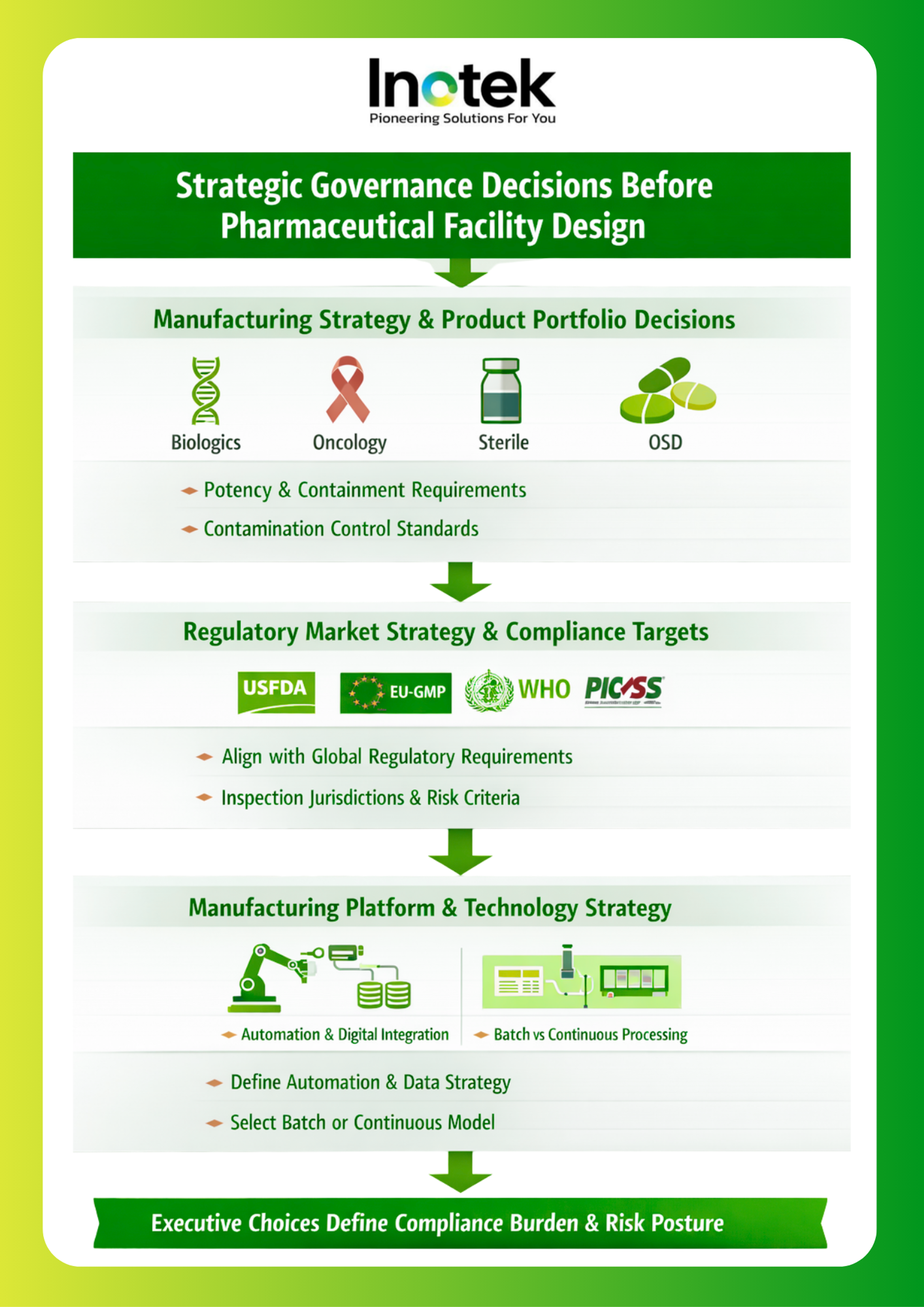
Manufacturing Strategy and Product Portfolio Decisions
- Product type considerations (biologics, oncology, sterile, OSD): Product modality dictates contamination control, intervention handling, utilities, and containment baseline.
- Potency classification and containment requirements: Potency determines segregation depth, pressure philosophy, and decontamination logic. Decide early to avoid structural rework.
Regulatory Market Strategy and Compliance Targets
- Alignment with EU-GMP, USFDA, WHO, PIC/S expectations: Plan to the strictest applicable expectation set; differences affect documentation depth, monitoring, and qualification evidence.
- Inspection Jurisdictions Influencing Facility Standards: Jurisdictions influence the rigor of classification, the depth of Quality Risk Management (QRM), data integrity, and the style of evidence. Late decisions constrain flexibility.
Determining Manufacturing Platform and Technology Strategy
- Automation and Digital Manufacturing Integration Planning: Define data capture, BMS/EMS integration, and electronic records at the concept stage to support control and inspection.
- Batch vs. Continuous Manufacturing Strategy: Platform choice determines equipment layout, hold strategy, utility demand, and the continued verification model.
Embedding the Pharmaceutical Validation Lifecycle Before Facility Design
Validation must shape requirements before engineering. Projects that align lifecycle thinking early show stronger inspection performance.
Stage-1 Process Design and Facility Planning
Process Capability and Equipment Sizing Implications
Capability defines realistic operating ranges and stability. Early sizing impacts rooming, access, cleaning, utilities, and the scope of qualification.
Alignment of Facility Logic with Validation Lifecycle Requirements
Arrange systems so IQ/OQ/PQ, monitoring, calibration, and investigations occur without operational compromise. This is where the pharmaceutical validation process becomes physical.
Validation Governance Before Engineering
Defining the Validation Master Plan Before Layout Development
The VMP defines scope, criticality, sequencing, and evidence structure. Establish before layout to align dependencies and inspection defense.
Implications of Installation Qualification (IQ) for Early Planning
IQ drives equipment selection, tie-in philosophy, access, materials records, and instrumentation. If not planned, IQ becomes inefficient and contentious.
Strategic Planning of Water Systems in Pharmaceutical Facilities
The water system in the pharma industry must be architected at the concept stage. PW/WFI decisions affect routing, sampling, maintenance, microbial control, and validation efforts.
Water System Architecture Decisions
Define generation, storage, loop configuration, redundancy, and routing in terms of demand and risk: Prioritize drainability, sanitisation, minimal dead legs, and defensible points of use.
Microbial Control Strategy for Water Systems
Select the control mode (thermal, chemical, or hybrid) and ensure that materials, instrumentation, and loop design support it. Link to alert/action levels and investigation pathways.
Alignment with Pharmaceutical Validation Process
Plan for sampling intensity, worst-case use, sanitization verification, and sustained control to keep the system in a validated state.
Monitoring and Sampling Strategy Before Engineering
Fix point-of-use locations, access, and frequency concepts early to avoid a compliant but weakly controllable loop.
Contamination Control Strategy Before Cleanroom and Layout Design
A compliant cleanroom in the pharmaceutical industry is the outcome of a defined contamination-control strategy, not labels.
Interpreting EU-GMP Cleanroom Expectations During Planning
Translate classification hierarchy, intervention risk, airflow intent, and control measures into a coherent model aligned to process exposure.
Zoning Strategy for Pharmaceutical Facility Layout Planning
The pharmaceutical plant layout must enforce the separation of product, personnel, material, waste, and maintenance flows.
- Personnel Flow Planning: Minimise crossings, simplify grooming, and align behaviour with control.
- Material Flow Segregation: Enable status control, quarantine discipline, and forward flow with clear sampling points.
- Contamination Segregation Logic: Define interactions of air, people, materials, and equipment to prevent events and support the inspection narrative.
Risk-Based Facility Logic in Pharmaceutical Plant Planning
Pharmaceutical plant design should be driven by contamination risk assessment at the concept stage.
Contamination Risk Assessment Influencing Facility Concepts
Use product properties, exposure, operator interaction, and cleaning limits to define area relationships and system boundaries.
- Containment Strategy for High-Potency Compounds: Adopt closed handling, containment pressure regimes, and decontamination workflows where required—decided before equipment placement.
- Segregation Decisions Influencing Facility Layout Logic: Let segregation drive corridors, airlocks, transfer paths, and interfaces—not the other way around.
Manufacturing Flow Strategy in Pharmaceutical Facility Planning
Treat the pharmaceutical plant layout design as an operating control system.
- Personnel and Material Movement Pathways: Design for clarity, line status control, and low-deviation execution.
- Cross-Contamination Prevention Through Facility Zoning: Zoning should reduce cross-contact risk and simplify defence in inspections.
Using the GMP Inspection Checklist to Guide Early Planning Decisions
A GMP inspection checklist should stress-test concepts while decisions are reversible.
Aligning Facility Planning with Pharmaceutical Inspection Expectations
Challenge whether the concept shows a clear link between risk, control, validation, and documented rationale.
Applying the FDA Inspection Readiness Checklist During Planning
Use an FDA inspection readiness checklist to force evidence-based thinking: justification, monitoring, traceability, and documentation at the concept stage.
When Organizations Should Engage Regulatory-First Facility Consulting
Engage early—before concept freeze—when targeting multiple markets or complex portfolios. Pharmaceutical plant design consultants with a regulatory-first focus help align interpretation, validation logic, and facility intent to avoid design-embedded observations.
Regulatory Interpretation Before Engineering Execution: Early interpretation identifies compliance risks, aligns cross-functional assumptions, and prevents rework once design constraints are fixed.
Make Early Facility Decisions That Stand Up to Regulatory Scrutiny
Across this article, one point is consistent: inspection outcomes are a consequence of concept-stage decisions.
"Inspection outcomes are not created during audits. They are built into the facility during early engineering decisions." - Sunil Lande, Managing Director, Inotek.
Segregation logic, contamination-control models, utility intent, validation scope, and documentation traceability either align early or create structural gaps later. Once the design is fixed, these gaps become difficult to correct.
The real leadership question is whether facility intent itself can withstand regulatory scrutiny. Because by the time an inspector asks that question, the answers are no longer being designed—they are already locked in.
How Inotek Supports Inspection-Ready Pharmaceutical Facility Planning
At Inotek, regulatory intelligence is embedded at the point where facility intent is defined—not after design maturity. Instead of treating GMP compliance as a downstream validation activity, the approach integrates regulatory interpretation into facility logic, project strategy, and validation planning. This enables organizations to eliminate design-embedded risks before they surface during CQV or inspection.
Key Areas Inotek Focuses On:
Strategic Governance Decisions Before Pharmaceutical Facility Design
Inotek supports project and engineering teams in defining zoning, segregation models, and contamination-control strategies aligned with global GMP expectations. By resolving these decisions at the concept stage, organizations avoid structural design choices that later translate into inspection observations.
Early Compliance Risk Assessment
Through structured concept reviews and risk-based evaluation, Inotek identifies regulatory gaps in layout logic, process flows, and cleanroom strategy before they are embedded into design. This shifts compliance from reactive correction to proactive control.
Engineering Decisions Aligned With Regulatory Frameworks
Critical engineering decisions—material and personnel flow, environmental control philosophy, and system criticality—are aligned with EU-GMP, USFDA, and PIC/S expectations. This ensures that facility behavior under operation and inspection is consistent with regulatory intent.
Validation Strategy and CQV Readiness
Inotek advises on validation master planning and CQV alignment so that facility design, system criticality, and documentation structures support defensible validation outcomes. The objective is clear: validation should confirm control, not expose design-stage gaps.
If regulatory interpretation is not driving your facility decisions at the concept stage, compliance risk is already being built in. The question is whether those risks are being identified now or deferred until inspection forces them into view.
Ready to evaluate whether regulatory interpretation is shaping your facility decisions early enough?
Book a consultation with Inotek to assess whether your facility logic will withstand inspection scrutiny—before it gets locked into design.
Visit www.inotek.co.in/contact-us.
FAQs
How do water system decisions affect inspection readiness in pharma facilities?
Water systems define control, not just supply. Loop design, dead-leg elimination, sanitization approach, and sampling strategy determine whether microbial control is demonstrable under inspection. Poor early decisions result in non-representative sampling, inconsistent control, and validation gaps that are difficult to justify during regulatory review.
When should pharmaceutical companies involve regulatory consulting in facility projects?
Regulatory consulting is most effective before concept freeze. Once zoning, flows, and system criticality are defined without regulatory alignment, correction becomes structural. Early involvement ensures facility logic, validation intent, and documentation strategy are aligned with inspection expectations from the outset.
How does the ICH validation lifecycle influence pharmaceutical facility planning?
The ICH lifecycle forces process knowledge into facility requirements. Stage 1 defines constraints that impact zoning, utilities, and equipment layout. If this translation is weak, facilities struggle during IQ/OQ/PQ, leading to non-representative testing, rework, and difficulty sustaining validated control.
Why is contamination control planning critical before designing cleanrooms?
Cleanroom classification without contamination-control logic is superficial. Exposure risk, intervention patterns, material transfer, and cleaning boundaries must define zoning and airflow strategy. Without this, facilities meet classification requirements but fail to demonstrate real control under inspection conditions.
How can regulatory-first consulting improve inspection readiness for pharma facilities?
Regulatory-first consulting ensures that facility decisions are driven by inspection logic rather than being retrofitted later. It aligns segregation, utilities, validation scope, and documentation with global expectations, reducing the risk of design-embedded gaps that typically surface during CQV or regulatory inspections.
More blogs
Related reading
8 Regulatory Decisions Before CGT Engineering Freeze

Dead Legs in Pharma Utilities: Why CAPA Cannot Fix Poor Design