
Design Warning Signs of Repeat CAPAs in Pharma Facilities
April 17, 2026

Repeat CAPAs = Design Warning Signs: Reading the Signals in GMP Facilities
You close the CAPA, the audit trail is clean, and the issue is "resolved." Then, weeks later, the same deviation reappears in the same zone.
For QA leaders, this is a cycle of frustration. For regulators, it’s a red flag. Repeated CAPAs often indicate systemic design issues rather than isolated process failures. When failures cluster around a specific airflow envelope or utility point, the question shifts from 'What went wrong?' to 'Why does your facility design allow this to happen?'
Repeat CAPAs: Why Regulators See Design Failure, Not Process Gaps
Regulatory scrutiny around CAPA has evolved significantly. Inspectors are no longer focused only on whether a deviation was investigated and closed — they are evaluating whether similar failures continue to appear across time, zones, or systems.
When recurrence patterns are visible, it raises a deeper concern: whether the facility’s design, control strategy, or validation scope truly reflects real operating conditions. Using tools such as Pareto analysis or trend mapping can help identify systemic weaknesses. In this context, repeated CAPAs are interpreted less as isolated quality events and more as idicators of system-level weakness.
A single CAPA demonstrates a response. Repeated CAPAs demonstrate instability.
The Point Where CAPAs Stop Being Quality Issues
In mature GMP environments, the distinction between occurrence and recurrence is rarely the real concern. What matters is the pattern.
When the same deviation returns after closure — especially in the same zone, utility, or process step — it signals that the system has not truly absorbed the correction. At that point, the discussion shifts from what failed to what is structurally allowing failure to repeat.
Recurrence is not just a quality signal. It is often the earliest indication that facility design, zoning logic, or validation assumptions are misaligned with how the operation actually runs.
What CAPA Trends Reveal About Your Facility Design
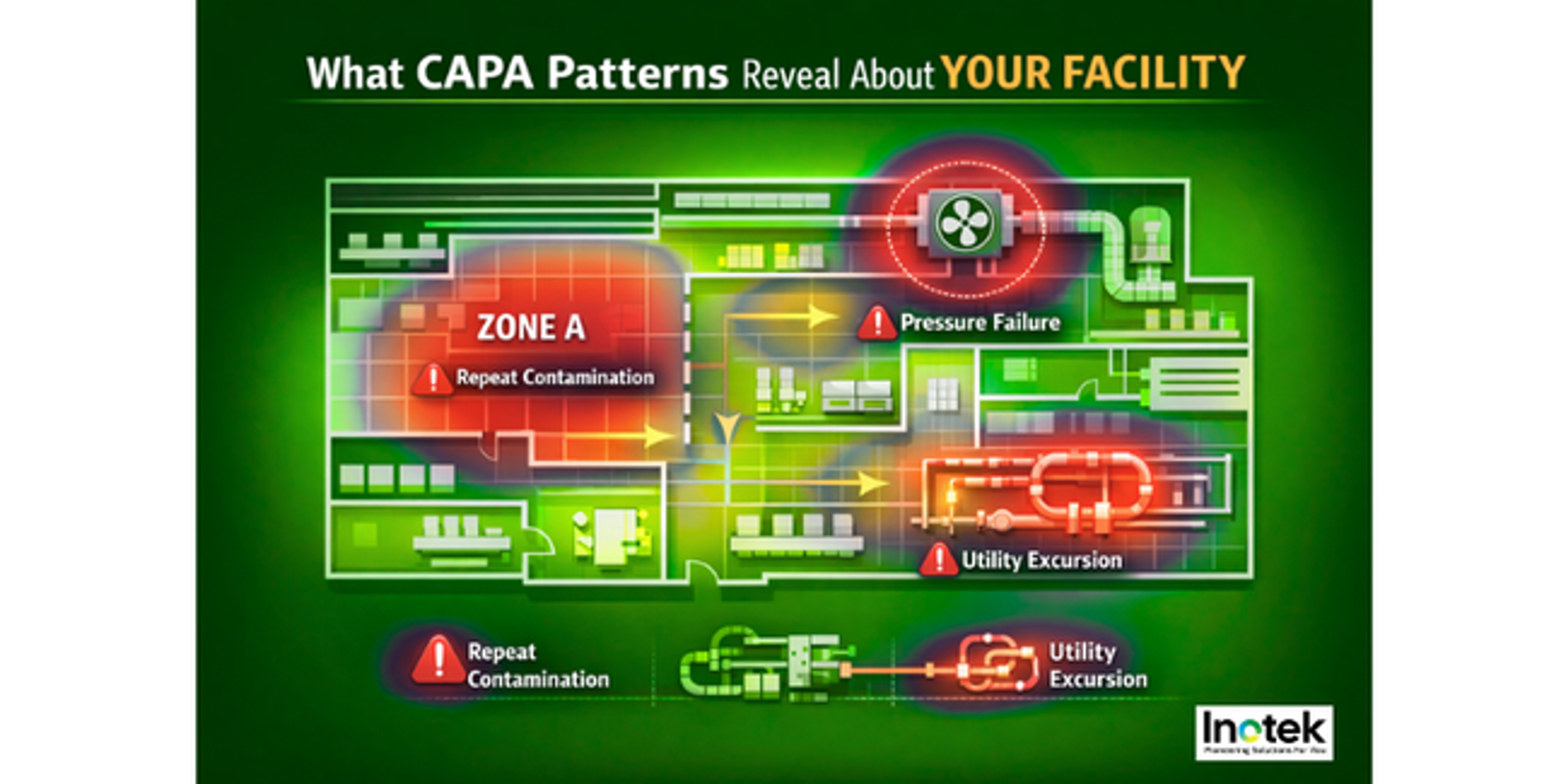
A single CAPA is an event. A group of CAPAs over time reveals a pattern. Recognizing these patterns around certain rooms or utility points can empower leadership to proactively address systemic weaknesses, fostering a sense of control and confidence in facility improvements.
Over time, these patterns form a map of the facility's weak points.
- Some areas consistently generate more issues.
- Some systems need repeated intervention.
- Some utilities fail under similar conditions.
In mature GMP environments, the distinction between occurrence and recurrence is rarely the real concern. What matters is the pattern. When CAPA trends reveal persistent issues in specific zones or systems, leadership can leverage this data to prioritize facility redesign or upgrades, ensuring resources are directed toward systemic weaknesses rather than symptoms.
Design Failure Patterns That Drive Repeat CAPAs:
Recurring CAPAs often point to underlying design decisions that, when addressed, can lead to meaningful improvements, inspiring leadership to view these patterns as opportunities for strategic facility enhancements rather than just problems to fix. Across GMP facilities, recurring CAPAs consistently map to a few core design conditions. These are not isolated problems; they result from design decisions interacting with actual plant operations.
- Zoning and Flow Conflicts: Inconsistent room classifications, intersecting material and personnel flows, and pressure-cascade instability often force operational compromises. These conditions lead to recurring deviations that cannot be permanently resolved through SOP adjustments.
- HVAC and Airflow Instability: Imbalanced air handling, weak cascade logic, and airflow behavior that changes under intervention or peak-load conditions frequently lead to repeated environmental failures.
- Utility Design Limitations: Dead legs, poor drainage, and stagnant zones in water or utility systems create recurring microbiological or particulate risks that reappear despite repeated cleaning or flushing actions.
- Validation Strategy Gaps: Systems validated under ideal conditions but not stress-tested in real operating scenarios often generate repeat CAPAs when exposed to routine variability.
These are not isolated problems. They are the result of design decisions interacting with actual plant operations.
Why Most CAPA Systems Fail to Stop Recurrence
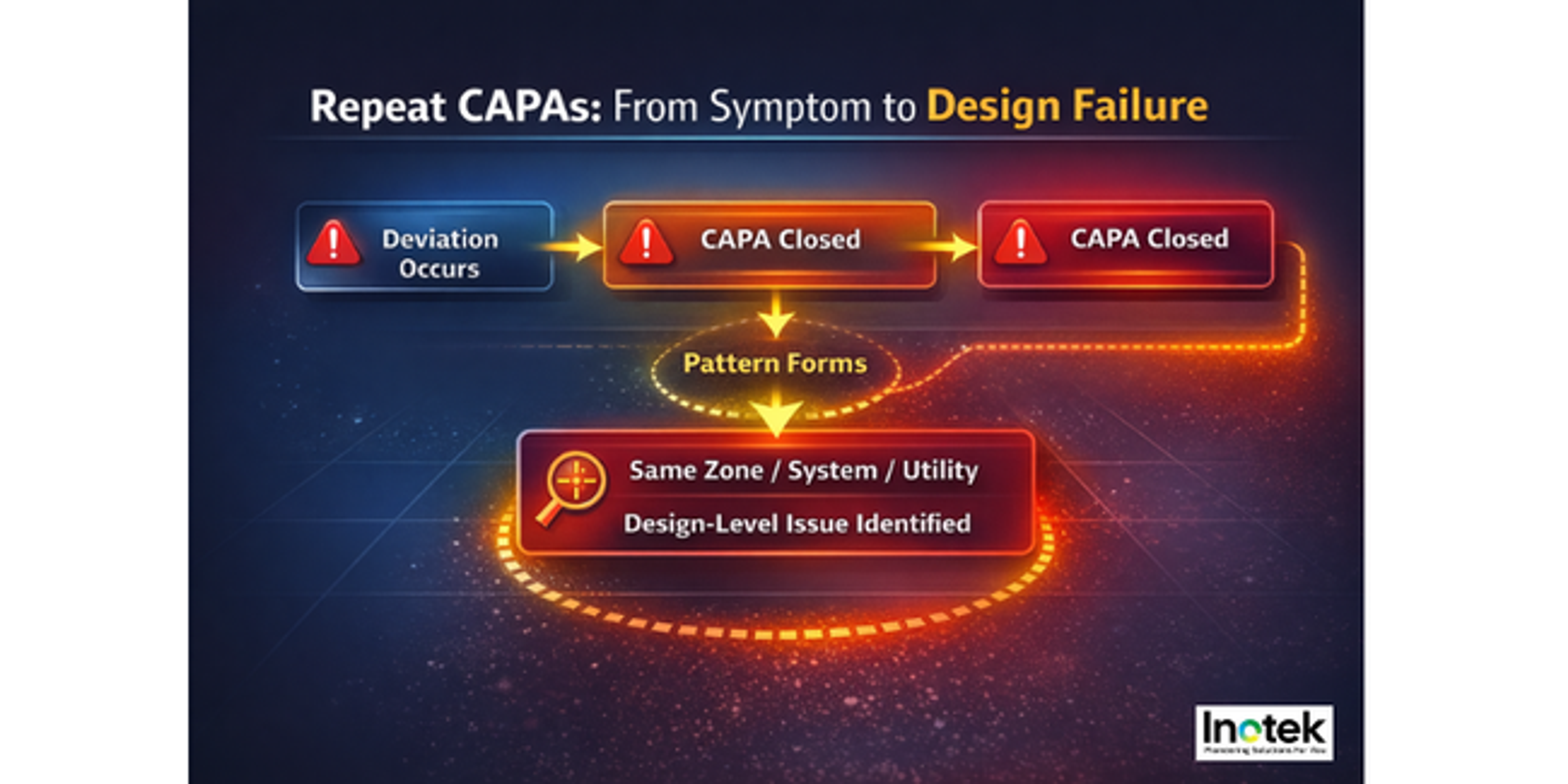
CAPA systems are usually designed to resolve deviations quickly. They are not always designed to prevent them from happening again.
Many investigations conclude with explanations like training gaps, procedural errors, or operator mistakes. These are easy to address and document. However, when the same issue recurs, it indicates the analysis did not go deep enough.
Often, the real cause lies in system design—zoning, airflow, utilities, or validation scope.
If root cause analysis does not reach this level, CAPAs will continue to fix symptoms rather than eliminate the root cause of the problem.
Using Deviation and CAPA Metrics to Spot Recurrence Patterns
CAPA trend data, when viewed over time, provides a far more meaningful signal than individual deviation reports. Patterns of recurrence—whether linked to a specific room, utility loop, or process stage—highlight where the system is consistently under stress.
When multiple CAPAs originate from the same operational environment, it suggests that the issue is not being resolved at its source. Instead, the system is compensating through repeated corrective actions. At this stage, CAPA data stops being a performance indicator and becomes a diagnostic tool—pointing directly to underlying design or control limitations.
For leadership, the metric to watch isn't "Total CAPAs Closed," but "CAPA Re-open Rate by Zone." This metric identifies the physical locations where compliance is most expensive and least stable.
Inspecting the Limits of 5 Whys in Pharma‑Level CAPA
Root cause methodologies, such as the 5 Whys, are widely used in CAPA systems. While effective in many scenarios, their impact depends heavily on how deeply the analysis is taken. In practice, investigations often conclude with operational explanations—such as training gaps, procedural lapses, or human error.
When recurrence persists, it typically indicates that the analysis has not extended far enough into design intent—whether in zoning logic, airflow behavior, utility configuration, or validation scope. Without that layer of insight, CAPAs resolve symptoms while leaving the underlying condition unchanged.
“If your 5‑Whys always ends at ‘training’ but the same spot keeps failing, your CAPA‑system is not insightful; it’s convenient.”
To be truly effective, the "5th Why" should often be an engineering question. Why did the operator fail to maintain the pressure? Because the airlock is too small for the equipment. Why is the airlock too small? Because the design intent didn't account for the new scale-up equipment. This is a design root cause, not a training one.
What Repeat CAPAs Are Actually Telling You
Every repeated CAPA is answering a question your system is not asking:
- Why does contamination reappear in the same Grade-A zone?
- Why does the same water loop fail at the same outlet?
- Why does intervention risk remain despite retraining?
Because the system was designed to allow it.
And until that changes, the CAPA will return — just under a different name.
Design Failure Patterns: Zoning, Layout, and System Constraints
Regulators and experienced reviewers increasingly identify zoning as a primary driver of design-related GMP observations. When zoning logic is misaligned with the actual process flow, the facility begins to rely on operator adjustments to maintain control. Over time, these adjustments become routine, and the resulting inconsistencies surface as repeat deviations.
The issue is rarely the absence of controls. It is the mismatch between how the facility is designed to function and how it is actually used.
When zoning boundaries are inconsistent, pressure cascades fail under routine movement, or material and personnel flows converge at fixed points, the system begins to behave predictably under stress. The same zones generate the same deviations. The same operational workarounds lead to the same CAPAs.
At that stage, recurrence is not accidental. It is structural.
Where Layout Compliance Breaks Down in Operation
A facility can meet GMP expectations on paper yet fail to maintain control in operation.
Layout compliance is often assessed through zoning diagrams, flow maps, and documented intent. However, these representations do not always capture how the facility behaves under real conditions—maintenance activities, storage pressures, intervention frequency, or scale-up demands.
When CAPAs repeatedly address issues through SOP adjustments, increased monitoring, or batch-specific controls, without revisiting the layout itself, the system shifts into a compensatory mode. The facility is no longer operating as designed—it is being managed around its constraints.
For leadership, this is the inflection point. The question is no longer how many CAPAs are being closed, but why the same conditions continue to generate them.
When CAPA Patterns Expose Validation Gaps
Repeat CAPAs within the same process, system, or utility often indicate that validation is not aligned with the facility's actual operations.
If the same cleanroom, transfer line, or utility loop continues to generate deviations, it suggests that validation has confirmed performance under defined conditions—but not under real operational variability.
This is where validation shifts from being a confirmation exercise to a diagnostic one.
A robust validation approach anticipates where systems are likely to fail under stress—whether at water loop extremities, transfer interfaces, or intervention-heavy zones—and builds that understanding into qualification and requalification strategy.
When CAPA trends are used to refine validation assumptions, the system evolves. When they are not, the same gaps persist under a validated state that no longer reflects reality.
HVAC and Utility Design: Where CAPA Loops Are Created
HVAC systems and pressure cascades directly influence how CAPA patterns emerge in cleanroom environments.
When airflow is unstable across operating conditions, or when pressure cascades break down at transition points, deviations begin to cluster around those areas. Over time, these clusters form consistent CAPA signatures tied to specific zones.
Similarly, utility design plays a critical role. Poorly configured loops, stagnant sections, inadequate drainage, or shared pathways across grades create conditions where contamination risk cannot be fully controlled.
In both cases, CAPAs that adjust monitoring, alarms, or procedures without revisiting system design will continue to repeat. This is the point at which regulators begin to interpret recurrence not as operational variability but as systemic design risk.
CAPA as a Feedback Signal for System Design
Each repeated CAPA is not just an event to be closed—it is a signal to be interpreted. When the same node appears consistently in CAPA data, it indicates that the system is not stable under actual conditions. At that point, continuing to treat each CAPA individually only reinforces the loop.
A more effective approach is to use CAPA patterns as input into system-level decisions:
- Identifying stress points in zoning and flow logic.
- Evaluating HVAC behavior under operational load.
- Reassessing utility design at recurring failure points.
- Updating the validation strategy to reflect observed conditions.
This is where CAPA shifts from reactive management to proactive system control. It turns the quality department into a strategic partner for engineering and operations.
The Cost of Repeating CAPAs vs Fixing Design
Repeated CAPAs carry both operational and strategic costs. At an operational level, they consume time, increase workload, and add layers of procedural complexity. Teams spend more effort maintaining control than improving it. This is "compliance friction."
At the system level, they create a culture in which recurring issues are managed rather than resolved. From a regulatory perspective, recurrence patterns indicate unresolved system weaknesses. Over time, these patterns can escalate into more serious findings, particularly when they point to design-related GMP observations. For leadership, this is where the cost of repeated CAPAs begins to exceed the cost of addressing the underlying design.
A single warning letter or a forced production shutdown costs exponentially more than a targeted engineering fix to a recurring zoning error or a faulty pressure cascade.
“If your CAPA‑trend data is not feeding into design‑level decisions, you’re not using it as a risk‑tool; you’re using it as a compliance‑paperweight.”
Inotek: Turning Repeat CAPAs into Design‑Level Insights and HACCP Readiness
Inotek helps QA and compliance leaders read repeat CAPAs not as process failures, but as early‑warning signals of design‑level vulnerabilities. As a regulatory‑first consulting partner, Inotek maps CAPA‑trend patterns to zoning logic, HVAC design, utility topology, and validation strategy in pharma, translating them into actionable redesign inputs that shift the facility's risk profile.
Request Your Facility‑Level CAPA & Design Review
If your CAPA‑trend dashboard shows recurring events in the same zone, utility, or HVAC string, it may be time to re‑examine the underlying design logic rather than simply adding another CAPA‑loop. A facility‑level CAPA & design review can help senior leadership:
1. Identify where repeat CAPAs cluster and how they map to zoning, layout, and HVAC logic.
2. Assess whether your validation strategy and validation master plan GMP align with design‑induced risks.
3. Pinpoint design‑related GMP observations—dead legs, zoning errors, poor flow, or HVAC imbalances—that can be resolved at the engineering level.
For CXOs, this is the moment to ask: “Are we closing CAPAs, or are we closing design‑level risk?” If the answer leans toward “We’re still closing CAPAs,” Inotek offers a structured path to turn those repeat‑CAPA patterns into design‑level control points—before regulators force the conversation. Get in touch with us at www.inotek.co.in/contact-us.
Frequently Asked Questions:
Q1. When are repeat CAPAs really a design-level problem rather than a process problem?
Repeat CAPAs signal design failure when specific zones or utility nodes relapse despite repeated retraining and SOP tightening. If root-cause analysis ignores zoning logic or airflow cascades, you are masking faults rather than fixing them. Recurring CAPA costs eventually outweigh targeted engineering-level investments.
Q2. What are “structural indicators of repeat CAPAs” in a GMP facility?
Indicators include recurring deviations in Grade-A/B zones, chronic zoning errors like bidirectional flow, and particulate excursions linked to HVAC topology. When CAPAs fail to address C&Q or validation layers, they aren't just quality events—they are stress tests of the facility's design and regulatory resilience.
Q3. Why does 5 Whys in CAPA often miss the real root cause?
While excellent for process causes, 5 Whys often misses design-level risks by landing on convenient "human error" conclusions. Effective pharma CAPAs must look beyond SOPs and examine design intent, airflow cascades, and zoning conflicts to identify why the environment, structurally, allows the failure to recur.
Q4. Are zoning errors in pharma really enough to trigger repeated CAPAs?
Yes. Inadequate zoning and pressure-cascade failures generate recurring contamination and cross-grade CAPAs. When flows improvise around a poor layout, every batch replays the same failure. SOP tweaks and extra monitoring only mask underlying zoning flaws rather than addressing the structural mismatch between design and reality.
Q5. How can CAPA-trend data be used to prevent future design-related GMP observations?
Treat trend data as design intelligence, not just compliance tracking. By mapping CAPA clusters to HVAC strings and zoning envelopes, leaders can anticipate future design-related observations. Feeding this into validation master plans turns CAPA loops into early-warning signals for an inspection-ready, proactive facility.
Q6. What is the difference between correction, corrective action, and preventive action in a CAPA-driven system?
Correction fixes immediate issues; corrective action addresses root causes; preventive action removes potential causes through design choices like zoning logic. Shifting from correction-heavy responses to design-driven preventive action is critical for senior leaders to reduce recurrence at the source and ensure long-term facility stability.
Q7. Why is CAPA-driven paper-fixing so dangerous for inspection readiness?
Revising SOPs and increasing monitoring creates an illusion of control while leaving design vulnerabilities intact. Regulators seek design-level changes, not just documentation volume. Repeated CAPAs in the same node without engineering or zoning adjustments signal systemic risk, indicating a facility that is merely reactive.
Q8. How can a senior leader use CAPA data to justify a facility-level design review or redesign?
Use trend reports to map repeated deviations to specific HVAC bundles or utility nodes. By showing that CAPA loops are proxies for design-level risk, you can justify redesigns as essential investments in risk mitigation. This transforms engineering expenses into strategic tools for inspection readiness and stability.
More blogs
Related reading

8 Regulatory Decisions Before CGT Engineering Freeze

Dead Legs in Pharma Utilities: Why CAPA Cannot Fix Poor Design