Future-Ready Biologics Manufacturing: Decisions That Prevent GMP Failure
Biologics manufacturing risk is often designed long before the start. See how early regulatory, engineering, QMS, and validation decisions shape inspection readiness.
July 24, 2026

Future-ready biologics manufacturing depends on aligning regulatory intent, facility design, engineering controls, quality systems and validation strategy before critical project decisions become fixed. The most serious GMP vulnerabilities are rarely created during routine operations alone. They are often embedded much earlier through weak zoning, flow, contamination-control, utility, documentation and lifecycle assumptions.
In biologics manufacturing, compliance failure rarely begins on the shop floor. It begins much earlier, when facility concepts, engineering assumptions, quality structures, and validation logic are approved without enough regulatory discipline.
"Typically, we treat compliance as a tax system... a painful and necessary thing. We are trying to break that perception and convert this compliance activity into a true business advantage." - Dr Sunil Lande, Founder and Managing Director, Inotek Technologies Pvt Ltd
In biologics, poor early decisions do not stay contained. They surface later as validation rework, contamination-control weaknesses, fragmented quality oversight, difficult investigations, limited scalability, and facilities that may be operationally complete but regulatorily fragile.
This is why future-ready biologics manufacturing cannot be approached as a narrow GMP exercise. It must be treated as an integrated leadership responsibility, connecting facility design, engineering logic, quality systems, validation strategy and lifecycle planning within one inspection-defensible framework.
This was the central focus of Inotek’s webinar, Building Future-Ready Biologics Manufacturing Organizations. For senior stakeholders who missed the live session, the implications extend well beyond webinar learning. They affect decisions that should be challenged before layouts are frozen, systems are selected and project constraints begin narrowing the available compliance options.
The Inotek Biologics Readiness Chain
Inotek defines biologics inspection readiness through a connected decision chain:
Regulatory Intent → Facility Design → Engineering Controls → QMS Architecture → Validation Evidence → Inspection Outcome
A biologics facility is only as inspection-ready as the weakest decision in this chain.
If regulatory intent is not translated into design, engineering teams compensate operationally. If engineering controls do not reflect actual process risk, the QMS becomes procedural rather than preventive. If quality and validation are introduced after core decisions are fixed, they are forced to document assumptions they did not shape.
Future-readiness therefore does not begin at qualification. It begins when leadership establishes a coherent and defensible design basis.
The Core Failure Pattern: Delivered for Startup, Not for Regulatory Durability
A biologics site can look sophisticated on paper and still be fundamentally fragile. The recurring problem is not always underinvestment. It is fragmented decision-making.
Design moves forward without enough regulatory challenge. Engineering is optimized around delivery logic. Quality is expected to create procedural controls around inherited constraints. Validation is left to formalize assumptions it did not influence.
“Inspection readiness is now expected by design—not assembled before inspection. The process owner should ask which risks can be designed out so they do not have to be managed operationally.” - Dr Sunil Lande, Founder and Managing Director, Inotek Technologies Pvt Ltd
Biologics manufacturing is too sensitive for these disciplines to operate independently. When cleanroom concepts, flows, zoning, contamination-control logic, utility philosophy and documentation structures are misaligned, the organization inherits a facility that is harder to qualify, harder to operate, harder to explain and harder to scale.
Future-ready manufacturing begins when leadership stops asking only:
- “Can this be built?” and starts asking:
- “Can this design remain compliant, operable and defensible throughout its lifecycle?”
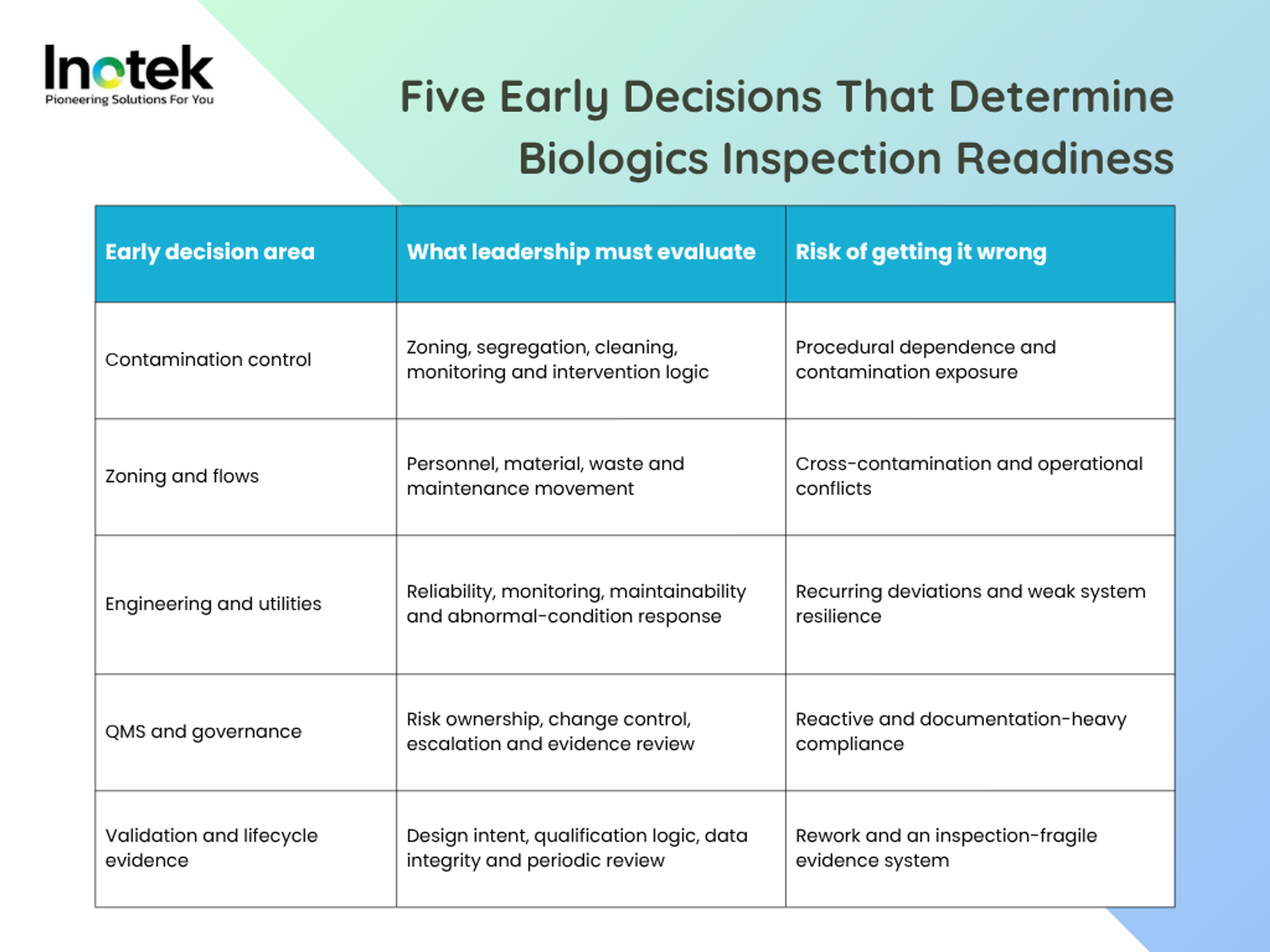
Five Early Decisions That Determine Biologics Inspection Readiness
1. Contamination-Control Assumptions
A contamination-control strategy should not be written after the facility is designed. It should influence the design basis itself.
The critical question is not whether individual controls exist. It is whether zoning, segregation, flows, environmental controls, cleaning strategies, interventions, maintenance access and monitoring systems operate as one coherent contamination-control architecture.
“CCS is not a quality document; it is an executive-owned operating strategy. The logic is: design first, then control, then monitor.” - Dr Sunil Lande, Founder and Managing Director, Inotek Technologies Pvt Ltd
When contamination control is treated primarily as a documentation exercise, risks that should have been eliminated through design are transferred to procedures, operator behaviour and investigation systems.
That is not a resilient control strategy. It is operational dependence created by an earlier design decision.
2. Zoning, Segregation and Flow Logic
Facility-design errors rarely announce themselves during concept meetings. They emerge during qualification, technology transfer, routine interventions, maintenance activities, deviation investigations or inspection.
Poor adjacencies. Weak personnel and material flows. Underdefined zoning. Shared pathways that appear manageable on drawings but become difficult during peak operations. Waste or maintenance routes that conflict with the intended contamination-control logic.
These are not minor engineering inconveniences. They are compliance liabilities.
“A good design reduces cross-contamination, human error and maintenance burden. A smart design also improves throughput, flexibility, batch reliability and scalability. The design basis is the first layer of regulatory defence.” - Dr Sunil Lande, Founder and Managing Director, Inotek Technologies Pvt Ltd
And yet facility decisions are still frequently shaped by project speed, cost pressure or execution convenience.
Inotek operates on a defining principle:
Regulatory compliance is achieved through informed decisions, not post-facto correction.
For biologics manufacturers, this means layouts should not be judged only by whether they are buildable. They should be tested against actual operating scenarios, intervention patterns, maintenance needs, contamination pathways and future process change.
3. Engineering and Utility Control Philosophy
Engineering choices in biologics environments are never neutral. They determine how reliably the facility protects the process, maintains controlled conditions, detects drift and supports compliant intervention.
Too often, engineering is treated as a technical delivery discipline rather than a regulatory decision domain. When engineering decisions are disconnected from GMP intent, the result is predictable:
- Excessive procedural controls
- Dependence on operator intervention
- Recurring deviations
- Difficult root-cause investigations
- Limited system resilience
- Greater inspection exposure
The leadership question should not be, “Does the system meet the current specification?” It should be, “Does the engineering philosophy remain maintainable, monitorable and defensible under routine and abnormal operating conditions?”
Where digital systems, analytics or AI-enabled tools are considered, governance must be equally disciplined.
“AI and analytics should only be used with validated systems, clear governance and defined human oversight. These tools may help identify patterns such as batch anomalies or equipment drift, but they do not replace accountable decision-making.” - Dr Sunil Lande, Founder and Managing Director, Inotek Technologies Pvt Ltd
In biologics, compliance should depend on intelligent system design and clear governance—not operator heroics.
4. QMS and Governance Architecture
One of the most common mistakes in biologics organizations is assuming that a strong QMS can be overlaid onto a weak facility.
It cannot.
A quality system is only effective when it reflects:
- How the facility is designed
- How the process actually operates
- Where critical risks are controlled
- Who owns key decisions
- How change is assessed
- How deviations and trends are escalated
- How evidence is generated and reviewed
When design intent, operating reality and documentation logic do not align, the QMS becomes reactive, deviation-heavy and inspection-defensive.
QMS maturity is not demonstrated by document volume. It is demonstrated by whether procedures, governance and evidence consistently reflect the regulatory intent of the facility and process.
Inotek’s advisory approach focuses on aligning quality systems with facility and process design from the earliest practical stage. This is critical because quality cannot sustainably govern a manufacturing environment it was not designed to understand.
5. Validation and Lifecycle Evidence
Many organizations still treat validation as a late-stage activity intended to formalize readiness after major decisions have already been made.
That approach reverses the logic of validation.
“Validation is the evidence architecture that connects design intent to operational performance. Periodic review identifies process capability and drift, helping the organization act before failure becomes a deviation.”
Validation cannot economically rescue weak zoning, poor maintainability, inadequate process flows or a utility philosophy that was never aligned with actual manufacturing risk.
Validation should challenge and confirm the design basis—not compensate for one that was never adequately established.
A future-ready validation strategy should therefore address:
- Design intent
- Critical process and system risks
- Qualification logic
- Acceptance criteria
- Data integrity
- Continued process verification
- Change management
- Periodic review
- Lifecycle evidence requirements
Inotek supports organizations in aligning validation strategy and master planning with relevant global regulatory expectations, including EU GMP, USFDA, WHO and PIC/S requirements.
The objective is not simply to complete qualification. It is to create an evidence system that remains coherent as the facility, process and product portfolio evolve.
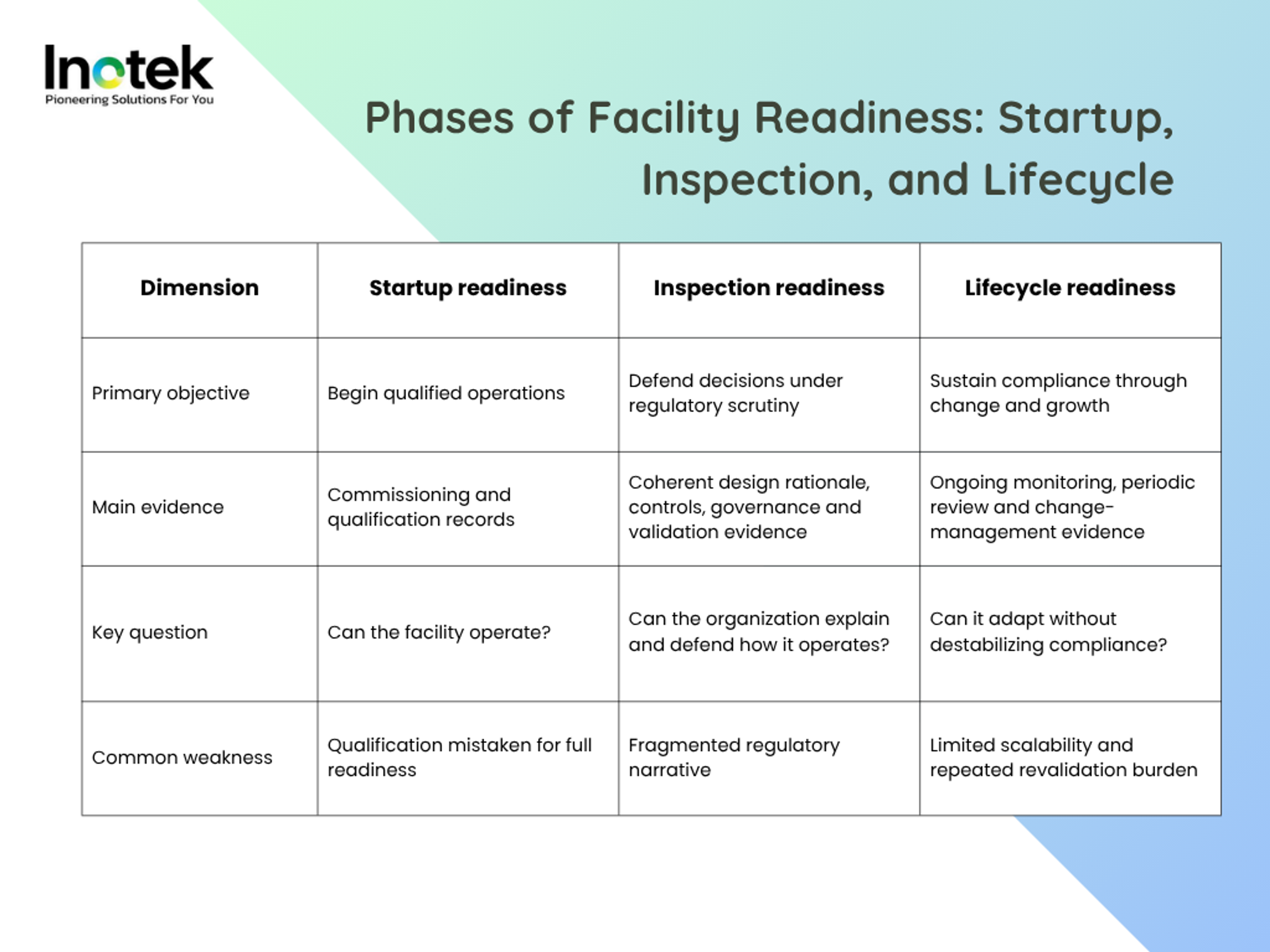
Why Startup Readiness Is Not Lifecycle Readiness
A facility may qualify successfully and still be poorly positioned for change, scale or sustained inspection resilience.
Startup readiness demonstrates that defined systems can enter operation. Lifecycle readiness demonstrates that the organization can continue to control, explain and adapt those systems without repeatedly destabilizing compliance.
Leadership should therefore challenge every critical decision against future consequences:
- Will the layout support product, process or capacity evolution?
- Will engineering systems remain maintainable and defensible?
- Will the QMS scale with operational complexity?
- Can the validation approach absorb change without repeated disruption?
- Will contamination-control assumptions remain valid as interventions change?
- Can the organization explain the original decision logic during inspection?
These are not merely project questions.
They are board-level manufacturing-risk questions.
The Common Risks Are Well Known. The Industry Still Repeats Them.
Most biologics project failures are not entirely unexpected. They frequently emerge from recurring decision patterns.
Treating compliance as downstream
Regulatory strategy is introduced after critical facility and engineering assumptions are already fixed.
Letting execution logic dominate compliance-critical decisions
Delivery pressure, budget constraints and implementation practicality influence choices that should first have been tested through a regulatory and lifecycle-risk lens.
Mistaking startup readiness for inspection readiness
A facility may be commissioned and qualified yet remain difficult to defend because its design, governance and evidence do not form a coherent regulatory narrative.
Treating validation as documentation closure
Validation teams are asked to create evidence for assumptions they were not involved in shaping.
Designing the QMS separately from manufacturing reality
Procedures are developed around organizational templates rather than the way the facility, process and control strategy will actually function.
None of these risks is new.
What remains surprisingly common is the belief that they can be corrected economically after design freeze. In many cases, they can only be managed - at greater cost, with greater procedural burden and with less regulatory confidence.
Can Validation Correct Weak Biologics Facility Design?
Validation can demonstrate whether a defined system performs as intended, but it cannot economically redesign poor zoning, inadequate segregation, weak maintainability or misaligned flows. A robust validation program begins early enough to challenge the design basis and confirm that facility, engineering and process assumptions can be supported with credible lifecycle evidence.
What Is the Difference Between Startup Readiness and Inspection Readiness?
Startup readiness shows that a facility can begin qualified operation. Inspection readiness requires the organization to explain and defend its design rationale, contamination controls, engineering decisions, quality governance, validation evidence and lifecycle strategy under regulatory scrutiny.
When Should Regulatory-First Consulting Intervene?
Regulatory-first consulting is most valuable before:
- The facility concept is approved
- Layouts and flows are frozen
- Critical systems are selected
- Procurement commitments are made
- Validation strategies are finalized
- Execution constraints limit the available options
EPC and execution partners are essential for project delivery. However, their commercial mandate is naturally shaped by scope, schedule, cost and implementation responsibility.
Independent regulatory-first consulting provides a separate challenge function. Its role is to test whether compliance-critical decisions remain defensible before delivery commitments restrict the alternatives.
Inotek Technologies Pvt. Ltd. is a regulatory-first consulting house serving pharmaceutical, biotech and life-sciences facilities. It provides independent design and engineering consultancy, international regulatory-readiness support, QMS consulting and validation advisory.
Inotek does not undertake EPC, supply, construction or turnkey execution.
This independence enables Inotek’s SMEs to evaluate facility design, engineering strategy, quality architecture and validation logic without execution bias.
For biologics manufacturers, this intervention is most valuable before the project reaches a stage where regulatory weaknesses can only be addressed through expensive redesign, operational controls or long-term procedural burden.
Questions Leadership Should Resolve Before Design Freeze
Before approving a biologics facility design basis, leadership should be able to answer:
- Which contamination risks have been eliminated through design rather than transferred to procedures?
- Do personnel, material, waste and maintenance flows remain defensible during real operating conditions?
- Does the zoning strategy reflect actual process and intervention risk?
- Are critical utilities designed around process protection, resilience and lifecycle monitoring?
- Does the QMS reflect how the facility and process will actually operate?
- Has validation strategy influenced the design, or is it being developed after decisions are fixed?
- Can the facility absorb process, product and capacity change without destabilizing compliance?
- Can leadership clearly explain the regulatory rationale behind every critical design choice?
If these questions cannot be answered before design freeze, the project may be progressing faster than its compliance logic.
Watch the On-Demand Webinar
Inotek Technologies Pvt. Ltd. and 7D Consultancy hosted Building Future-Ready Biologics Manufacturing Organizations for CXOs, managing directors, general managers, plant directors and other senior professionals involved in biologics manufacturing strategy, planning and operations.
The session addressed a problem many organizations continue to underestimate:
Biologics manufacturing performance is not determined at commissioning. It is shaped much earlier through the decisions that establish GMP alignment, facility design, engineering logic, quality systems, validation strategy and lifecycle readiness.
In biologics, competitive advantage does not come only from how quickly a facility is built.
It comes from how intelligently critical decisions are made before compliance risk becomes operational reality.
Request a Regulatory-First Review
Before layouts are frozen or execution commitments restrict your options, Inotek can independently review the regulatory, engineering, QMS and validation assumptions shaping your biologics facility.
The objective is not to redesign the project after failure. It is to identify decisions that may become difficult to qualify, operate or defend before they become embedded in the facility.
[Request a Regulatory-First Consultation]
FAQs
What is a future-ready biologics manufacturing organization?
A future-ready biologics manufacturing organization aligns GMP expectations, facility design, engineering controls, quality systems, validation and lifecycle planning from the beginning rather than treating them as separate workstreams.
Its readiness is demonstrated not only by successful startup, but by its ability to remain compliant, adaptable and inspection-defensible as products, processes and regulatory expectations evolve.
Why is facility design so important in biologics manufacturing?
Facility design shapes zoning, segregation, personnel and material flows, contamination control, maintainability and operational flexibility.
Weak early design assumptions often create downstream validation complexity, procedural dependence and inspection exposure that become difficult or expensive to correct later.
How do engineering decisions affect GMP compliance in biologics facilities?
Engineering decisions influence how reliably the facility supports controlled environments, process protection, utility performance, monitoring, maintenance and compliant intervention.
They should therefore be treated as regulatory decisions with lifecycle consequences—not merely technical procurement choices.
Why can quality systems not be developed in isolation?
Quality systems are effective only when they align with facility design, process realities, control strategies and decision ownership.
When the QMS is disconnected from how the site actually operates, compliance becomes reactive and documentation-heavy rather than preventive.
What role does validation play in future-ready biologics manufacturing?
Validation should confirm that design intent, engineering systems and process controls perform consistently and generate defensible lifecycle evidence.
It should begin early enough to challenge assumptions, not merely document them after the facility has been built.
What are the most common risks in biologics manufacturing projects?
Common risks include fragmented planning, late regulatory involvement, weak lifecycle foresight, poor validation planning, misaligned QMS architecture and facility-design decisions that transfer avoidable risks into operational procedures.
Can a compliant biologics facility still be inspection-fragile?
Yes. A facility may meet qualification requirements and still remain inspection-fragile when its design rationale, contamination controls, quality governance and validation evidence do not form a coherent and defensible regulatory narrative.
At what project stage should inspection readiness be assessed?
Inspection readiness should be assessed during concept development and revisited throughout design, engineering, qualification and lifecycle planning. Waiting until pre-inspection preparation is too late to correct many structural decisions economically.
How is Inotek different from EPC or execution-led firms?
Inotek operates as a regulatory-first consulting house, not an EPC contractor, turnkey vendor, supplier or construction firm.
Its role is to provide independent, SME-led challenge and decision support across facility design, engineering risk, regulatory readiness, QMS architecture and validation strategy—without commercial pressure to execute or supply the systems being evaluated.
More blogs
Related reading
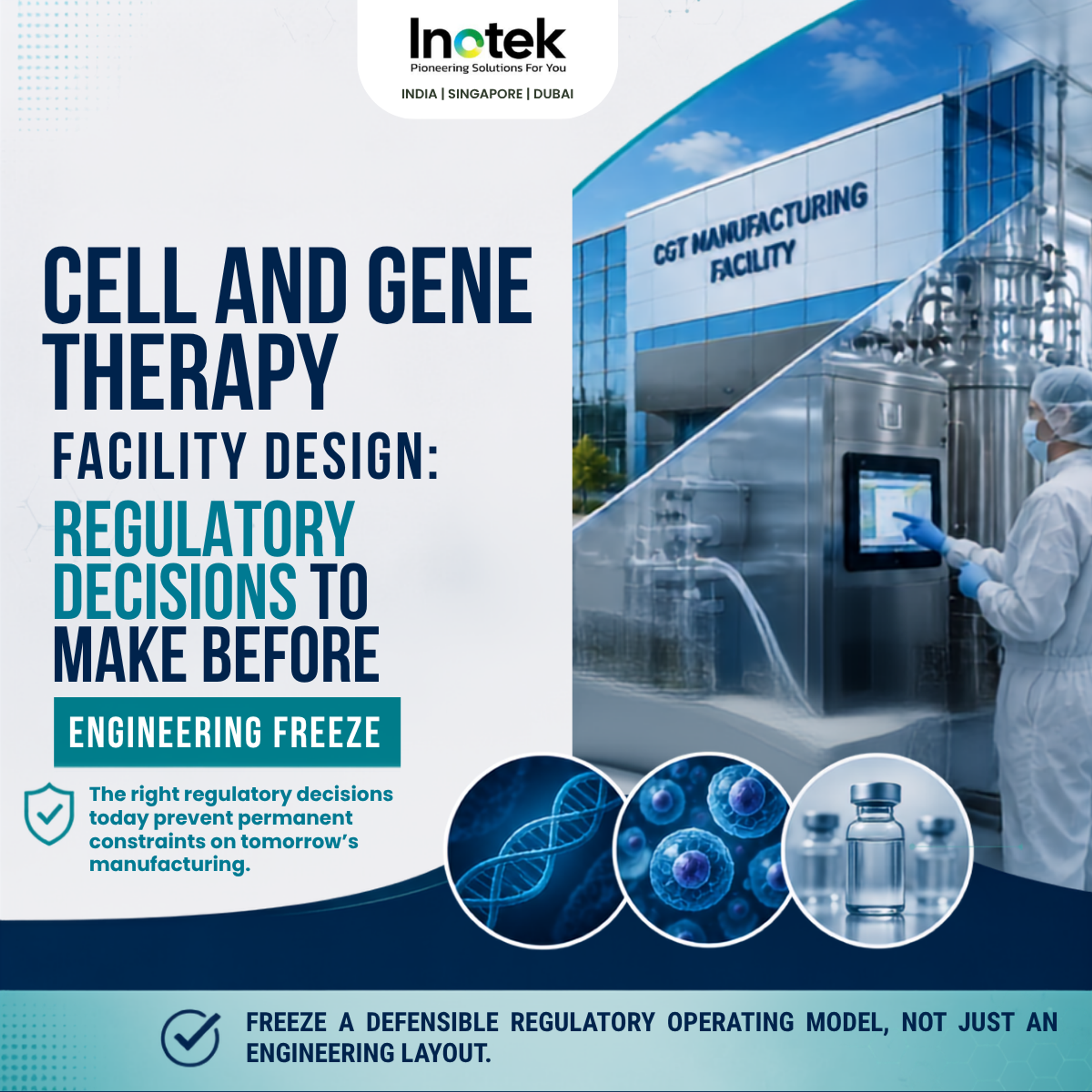
8 Regulatory Decisions Before CGT Engineering Freeze
Dead Legs in Pharma Utilities: Why CAPA Cannot Fix Poor Design