
Brownfield Pharma Expansion: 8 Regulatory Risks | Inotek
Assess 8 regulatory risks before a brownfield pharma retrofit, from GMP-impact boundaries and qualified capacity to requalification and interim-state control.
August 31, 2026
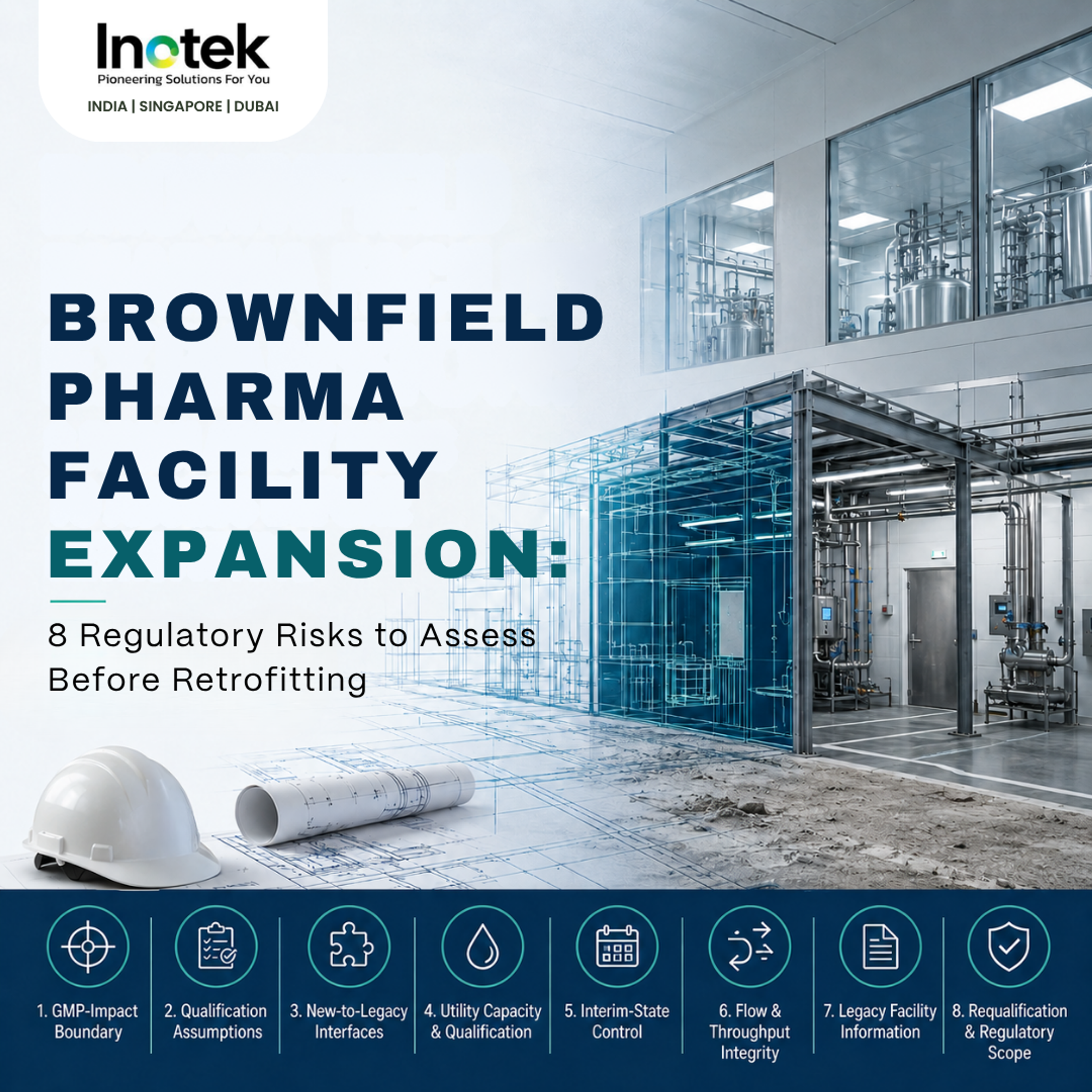
A brownfield pharmaceutical expansion can look contained on a project drawing and still create regulatory consequences across the operating facility. The risk is not simply whether the new suite, equipment or utility connection can be qualified. It is whether the change alters conditions on which the existing facility's validated state, contamination-control strategy or operating controls already depend.
That is why leadership should resist treating brownfield retrofit risk as an engineering coordination problem. EU GMP Annex 15 requires planned changes to facilities, equipment, utilities and processes to be assessed for their impact on validated status or the control strategy, with change evaluation extending to validation, regulatory status, maintenance and any necessary requalification.
What Are the Main Regulatory Risks in a Brownfield Pharma Expansion?
The principal risks are an underestimated GMP-impact boundary, invalidated qualification assumptions, weak new-to-legacy system interfaces, utility capacity that is available but not demonstrably qualified, uncontrolled interim operating states, flows that no longer remain suitable at increased throughput, unreliable legacy facility information, and a requalification or regulatory scope that expands beyond the original project estimate.
For the C-suite, these are not eight technical checks to delegate after design. They are eight reasons to challenge the investment basis before design freeze, procurement and shutdown commitments reduce the organization's room to change course.
1. How Far Does the Regulatory Impact Extend Beyond the Retrofit Area?
The first brownfield risk is assuming that the physical project boundary defines the compliance boundary. It rarely does. A local AHU modification may alter pressure relationships in adjacent areas; a new utility connection can change performance elsewhere in the distribution system; a revised access route can affect contamination-control assumptions well outside the construction zone.
A more defensible brownfield decision separates three boundaries: the construction boundary, where physical work occurs; the GMP-impact boundary, where the change can influence controlled systems, flows or established assumptions; and the qualification boundary, where evidence is required to demonstrate that control remains acceptable. Annex 15's change-control requirements support exactly this wider view by requiring assessment of unintended consequences and any necessary verification or requalification.
Inotek Brownfield Impact Boundary Model: the regulatory impact of a retrofit should be traced until its GMP consequence stops, not merely until its physical connection stops. If those three boundaries are assumed to be identical, the project may be under-scoped before execution even begins.
2. Which Existing Qualification Assumptions Will the Expansion Invalidate?
Every qualified facility operates on assumptions, whether they are explicitly stated or buried across URSs, qualification protocols, airflow studies, utility calculations, risk assessments and operating procedures. Occupancy, room pressure, heat load, utility demand, cleaning frequency, door-opening patterns and production volume can all form part of the conditions under which the original conclusion of control was reached.
The critical pre-retrofit question is therefore not only what is changing, but what must remain true for the existing qualification conclusions to remain defensible. ICH Q9(R1) specifically expects risk questions to identify pertinent assumptions and recognizes that uncertainty and gaps in knowledge affect the robustness of risk-based decisions.
This creates a useful leadership test: if the expansion changes a condition that supported the existing state of control, the fact that the affected legacy equipment was not physically modified does not eliminate the need for reassessment.
3. Where Can New-to-Legacy Interfaces Destabilize GMP Control?
Brownfield projects are most vulnerable where new systems meet old ones. A new cleanroom, production line or utility skid may satisfy its specification independently while creating a different operating condition once integrated into legacy HVAC, utilities, controls, drainage, access routes or monitoring architecture.
EU GMP Annex 1 is particularly relevant for sterile and contamination-sensitive facilities because it requires the Contamination Control Strategy to consider controls collectively and explicitly states that interactions between existing systems should be understood. The regulatory question is therefore not whether each new component complies; it is whether the integrated facility continues to behave in a controlled and explainable way.
For leadership, this is where apparently efficient brownfield decisions can create disproportionate exposure. Shared infrastructure lowers CAPEX only if the resulting system dependencies remain technically robust, monitorable and inspection-defensible.
4. Is the Facility's “Spare Capacity” Actually Qualified Capacity?
“Twenty per cent spare capacity” can sound like a decisive engineering answer. It is not yet a GMP answer.
A purified-water loop may have additional hydraulic capacity while the revised demand pattern affects circulation, sanitization or return conditions. An AHU may have available fan capacity while additional room volume, occupancy or heat load changes pressure stability and recovery performance. The same distinction applies to clean steam, process gases, compressed air and other critical utilities.
FDA's process-validation guidance defines utility and equipment qualification around suitability for intended use and proper performance across anticipated operating ranges, including operation under expected load.
The distinction leadership should retain is simple: available capacity is an engineering conclusion; qualified capacity is a GMP conclusion. Brownfield CAPEX should not be approved on the first when the facility ultimately has to defend the second.
5. Can GMP Control Be Defended During Every Interim Construction State?
A brownfield facility does not move directly from its current qualified condition into its final expanded condition. It passes through temporary barriers, shutdowns, utility isolations, revised access routes, partial HVAC states, commissioning interfaces and phased handovers. Where manufacturing continues, those are not simply construction phases; they are temporary GMP operating conditions.
That matters because controls that are robust in the final design may be weakened during the transition. Temporary segregation can affect airflow and personnel movement. Utility intervention can change system availability. Construction access can introduce contamination pathways that do not exist in either the original or completed configuration.
This leads to another brownfield principle worth making explicit: the project must control the transition, not merely qualify the destination. Temporary-state risk should therefore be challenged during execution planning, before the schedule becomes dependent on operating assumptions that QA has not yet accepted.
6. Will Existing Personnel and Material Flows Remain Acceptable at Higher Throughput?
Preserving an existing route is not the same as demonstrating that it remains suitable after expansion. A corridor that supported one production volume may experience materially different personnel density, staging pressure, waste movement, maintenance traffic and door-opening frequency after capacity increases.
21 CFR 211.42 requires appropriate facility space and the flow of materials through the building to prevent contamination and mix-ups. For brownfield decisions, that expectation should be tested against the future operating scenario, not against the fact that the existing arrangement previously passed qualification.
The leadership question is therefore not “Can we retain the existing flow?” It is whether the existing flow philosophy remains defensible at the scale, frequency and complexity the business is now asking the facility to support.
7. Can Leadership Trust the Existing Facility Baseline?
A brownfield risk assessment is only as reliable as its understanding of the plant that already exists. That becomes problematic in facilities that have accumulated years of minor modifications, CAPAs, maintenance interventions, undocumented routing changes, temporary fixes or drawing revisions that do not fully reflect physical reality.
If the baseline is unreliable, even a sophisticated risk assessment can reach the wrong conclusion because it is analyzing a configuration that exists in documentation rather than on site. ICH Q9(R1)'s emphasis on knowledge, assumptions and uncertainty is relevant here: greater uncertainty in an important and complex decision warrants greater rigour, not a more convenient assumption.
Before approving a major retrofit, leadership should therefore expect an existing-state regulatory baseline that reconciles physical configuration, controlled drawings, qualification status, change history, recurring deviations and CAPAs, and relevant regulatory commitments. This is not an as-built survey. It is the evidence base on which the retrofit's regulatory logic will stand.
8. How Far Could Requalification and Regulatory Scope Expand?
One of the most expensive brownfield surprises is discovering late that the qualification scope is much larger than the construction scope. Annex 15 requires planned changes to be evaluated not only for product-quality impact but also for validation, regulatory status, maintenance and required requalification.
For GCC manufacturers, this is not merely an EU-market consideration. The Saudi Food and Drug Authority's GMP Guide similarly requires planned changes to facilities, equipment, utilities and processes to be assessed for their impact on validated status or control strategy, with qualification and validation scope based on documented risk assessment.
The financial implication is significant. If the requalification boundary, dossier impact or operational-release requirements are discovered after equipment orders and shutdown dates are committed, regulatory uncertainty converts directly into schedule and CAPEX exposure.
How to Assess Regulatory Risk Before a Brownfield Pharma Retrofit
A brownfield retrofit should be assessed as a change to the existing GMP system, not simply as a construction project within an operating facility. The objective is to determine how far the proposed change can affect established controls, qualified systems and regulatory assumptions before design, procurement and shutdown commitments become difficult to reverse.
Step 1: Establish the Construction, GMP-Impact and Qualification Boundaries
Begin by separating the area where physical work will occur from the areas where GMP consequences may extend. The construction boundary, GMP-impact boundary and qualification boundary should not be assumed to be identical. Trace the effect of the proposed change through connected systems, utilities, flows and environmental controls until its potential GMP consequence stops.
Step 2: Identify Existing Qualification Assumptions
Determine which assumptions support the facility's current qualified state and whether the retrofit will disturb them. These may include occupancy, airflow, pressure relationships, utility demand, heat load, cleaning frequency, production volume or operating patterns. Where an assumption changes, the existing qualification conclusion may need to be reassessed even if the affected equipment or area is not physically modified.
Step 3: Assess New-to-Legacy Interfaces
Evaluate every point where new infrastructure will interact with existing HVAC, utilities, controls, drainage, monitoring systems, access routes or other facility systems. Individual components may meet their specifications while the integrated system behaves differently once connected. The assessment should therefore establish whether the combined facility remains controlled, monitorable and technically defensible.
Step 4: Verify Qualified Utility Capacity
Do not treat engineering spare capacity as evidence that a utility can support the proposed expansion within its qualified state. Additional demand can change circulation, pressure, sanitisation, recovery, redundancy and system behaviour. Utility capacity should therefore be assessed against the anticipated operating range and the conditions under which qualified performance must continue to be demonstrated.
Step 5: Assess Interim Operating States
Identify the temporary conditions the facility will pass through during execution, including shutdowns, temporary barriers, utility isolations, revised access routes, partial HVAC configurations and phased handovers. Where manufacturing continues, each temporary configuration should be treated as an operating condition requiring its own GMP risk logic rather than relying only on the final-state qualification strategy.
Step 6: Reassess Personnel and Material Flows
Test whether existing personnel, material, waste and maintenance routes will remain suitable under the future operating scenario. Increased production volume, headcount or movement frequency can change congestion, staging pressure, door-opening patterns and contamination-control conditions. The assessment should therefore reflect the expanded facility's expected throughput rather than historical acceptability alone.
Step 7: Establish the Existing-State Regulatory Baseline
Confirm that the regulatory assessment is being performed against the facility that actually exists. Reconcile the physical configuration with controlled drawings, qualification records, change history, deviations, CAPAs and relevant regulatory commitments. Where uncertainty exists in the legacy baseline, the level of verification should increase accordingly before retrofit decisions are finalised.
Step 8: Define Requalification and Regulatory Scope
Determine which systems, areas and operating assumptions will require verification, reassessment or requalification as a consequence of the change. The review should also identify potential regulatory impact, QA release requirements and documentation implications. Establishing this scope before CAPEX, procurement and shutdown commitments are fixed reduces the risk of regulatory requirements emerging after the project has lost flexibility.
The Brownfield Decision Leadership Should Make Before Design Freeze
Before a brownfield pharmaceutical retrofit moves into committed execution, leadership should be able to explain three things with confidence:
- Which existing assumptions the change disturbs
- How far that impact propagates through the operating facility and
- What evidence will be required to demonstrate that control has been maintained or restored
That is a more demanding standard than confirming buildability. It also explains why the conventional brownfield sequence, engineering the solution first and asking QA to validate its consequences later, can become expensive. Once procurement, shutdown planning and execution contracts are fixed, every challenge to the original design carries a commercial penalty.
EPC and execution partners remain essential to delivery, but their mandate is necessarily shaped by scope, cost, schedule and implementation responsibility. Independent regulatory-first consulting serves a different purpose: it challenges whether the proposed brownfield strategy is defensible before the organization becomes commercially committed to defending it.
Brownfield Expansion Is a Change to the Existing GMP System, Not Just an Addition to It
A successful brownfield expansion is not defined by whether the new area can be commissioned on time. It is defined by whether the enlarged facility can still demonstrate a coherent state of control across legacy systems, new interfaces, temporary operating conditions and the final qualified configuration.
Inotek Technologies operates at this decision point as a regulatory-first consulting house, providing independent design, engineering, regulatory, QMS and validation intelligence without EPC, supply or construction bias. The objective is to identify compliance-critical assumptions before they become physical constraints and to establish a qualification and regulatory logic that can withstand both operational reality and inspection scrutiny.
For senior leadership considering a brownfield pharma facility expansion, the priority is therefore not to ask how quickly the retrofit can begin. Establish first how far its regulatory consequences can travel, and whether the organization is prepared to defend every decision along that path.
Request an independent regulatory-first review from Inotek before the brownfield design basis, qualification scope and execution commitments become difficult to change.
Frequently Asked Questions:
1. What are the main regulatory risks in a brownfield pharmaceutical facility expansion?
The principal risks are underestimating the GMP-impact boundary, disturbing existing qualification assumptions, creating weak new-to-legacy interfaces, relying on unverified utility spare capacity, losing control during interim construction states, overloading existing personnel and material flows, relying on inaccurate facility baselines, and underestimating requalification or regulatory scope. These risks should be assessed before design freeze because their consequences can extend well beyond the physical retrofit area.
2. Does a brownfield pharma facility expansion require requalification?
Not automatically for every existing system, but the need for requalification should follow the impact of the change, not simply the construction boundary. If a retrofit alters operating conditions, critical utilities, environmental controls, validated assumptions or connected systems, affected legacy areas may require documented verification or requalification even when they are not physically modified.
3. How should the GMP-impact boundary of a brownfield retrofit be determined?
The GMP-impact boundary should be established by tracing how the proposed modification can affect existing systems, flows, utilities, contamination controls and qualified operating assumptions. It should be considered separately from both the physical construction boundary and the eventual qualification boundary. Inotek refers to this as the Brownfield Impact Boundary Model: Construction Boundary → GMP-Impact Boundary → Qualification Boundary.
4. Why is spare utility capacity not enough for a GMP expansion decision?
Spare capacity shows that a utility may be able to supply additional demand, but it does not demonstrate that the system will remain within its qualified operating state. Changes in demand can affect circulation, pressure, sanitization, recovery, redundancy or control behavior. Available capacity is an engineering conclusion; qualified capacity is a GMP conclusion.
5. Can pharmaceutical manufacturing continue during a brownfield retrofit?
It can, provided the manufacturer can demonstrate that GMP controls remain effective throughout every temporary operating configuration. Temporary barriers, utility isolations, revised access routes, partial HVAC states and construction interfaces can each introduce different contamination and control risks. The transition therefore needs its own risk logic rather than relying solely on final-state qualification.
6. How can HVAC modifications affect existing qualified areas?
An HVAC change can influence more than the room being modified. Revised airflow volume, return-air paths, pressure cascades, occupancy loads, exhaust conditions or recovery performance can affect adjacent classified or controlled areas. This is why HVAC retrofit assessment should focus on the behavior of the integrated system rather than qualification of the new component alone.
7. Why should existing personnel and material flows be reassessed during expansion?
Existing routes may have been acceptable at the original throughput but become higher risk after production volume, headcount or movement frequency increases. More traffic can affect congestion, door-opening frequency, waste transfer, staging and contamination-control assumptions. The correct question is whether the existing flow philosophy remains defensible under the future operating condition.
8. What should leadership establish before approving a brownfield pharma retrofit?
Before committing CAPEX and detailed engineering, leadership should know which existing GMP assumptions the project will change, how far those effects can propagate, which systems may require reassessment or requalification, how interim construction states will remain controlled, and what evidence QA will require before the expanded facility is released for routine operation. Resolving these questions early preserves both regulatory defensibility and project flexibility.
More blogs
Related reading

8 Regulatory Decisions Before CGT Engineering Freeze

Dead Legs in Pharma Utilities: Why CAPA Cannot Fix Poor Design