Publisher
India Pharma Outlook
published at
October 1, 2025
Comprehensive Guide to Establishing an API Facility in Russia
What challenges do pharma companies face when setting up manufacturing facilities in new markets? In Russia, the task of building an Active Pharmaceutical Ingredient (API) facility is not just about infrastructure; it’s about navigating regulations, managing timelines, securing investments, and ensuring long-term compliance. For global pharma players, the stakes are high: achieving self-reliance in critical drug production while meeting GMP standards.
This guide takes you inside the process, offering a clear roadmap of regulatory frameworks, project execution strategies, market opportunities, and investment insights, along with real case studies. With Inotek’s proven expertise in engineering audit-ready plants, you’ll discover how to transform these challenges into a competitive advantage in Russia’s evolving pharma landscape.
Regulatory Framework for API Facilities in Russia
Setting up an API facility in Russia requires navigating a structured regulatory framework designed to ensure product quality, safety, and compliance with local and regional standards. Understanding legal approvals, GMP requirements, and environmental regulations is essential for successful project execution and operational readiness.
Legal Requirements & Approvals
Establishing an API facility in Russia requires formal approval from the Federal Service for Surveillance in Healthcare. API registration, officially termed as "Enrollment to the State Register of the Russian Federation," is mandatory for all commercial APIs. Manufacturers must submit an application detailing the manufacturing site, quality control systems, and adherence to GMP standards.
The process differentiates between three API categories: registered commercial APIs, which can be legally marketed and contracted to multiple local manufacturers; APIs linked to a registered finished drug product (FDP), restricted to use specified in the registration dossier; and non-registered APIs, which are prohibited from commercial import or marketing in Russia.
An EAEU GMP certificate is also required, ensuring the facility complies with the unified quality standards of the Eurasian Economic Union. This certification validates the manufacturing processes, quality management systems, and facility conditions in alignment with regional regulatory expectations.
Compliance with GMP & Local Standards
Compliance with Good Manufacturing Practice (GMP) is critical for quality assurance and operational credibility. Russian GMP standards are harmonized with EAEU GMP guidelines, requiring facilities to undergo inspections and demonstrate adherence to production and quality standards. The focus includes process control, personnel training, documentation, and equipment qualification..
Environmental compliance is also integrated into the regulatory approval process. API facilities must implement measures to minimize emissions, manage waste, and maintain sustainable operations in accordance with local environmental standards. These requirements ensure safe production while supporting long-term operational viability within the Russian pharmaceutical market.
Project Timeline & Infrastructure Considerations
Establishing an API facility in Russia requires careful planning, coordinated construction, and systematic validation to ensure operational efficiency and regulatory compliance. Understanding the project phases helps stakeholders manage timelines, costs, and resource allocation effectively.
Planning & Feasibility Phase
The planning phase for an API facility in Russia begins with a comprehensive feasibility study to assess market demand, regulatory compliance, and potential operational risks. Strategic site selection is critical, considering proximity to raw material suppliers, transport links, and access to a skilled workforce.
ChemRar’s full-cycle manufacturing facility in Khimki demonstrates the importance of integrating research, development, and production at a single site, ensuring efficiency and alignment with national pharmaceutical priorities.
Construction & Equipment Installation
Construction begins after planning approval, involving facility design, equipment procurement, and adherence to regulatory standards. ChemRar’s project in Khimki, backed by the Industry Development Fund and the Moscow Region government, emphasizes coordinated construction for a high-tech API production line capable of supporting innovative and import-substituting medicines.
The facility layout is optimised for production efficiency, including storage areas, intermediate synthesis workshops, and dedicated lines for active pharmaceutical ingredients. Collaborative project management ensures adherence to timelines and regulatory requirements.
Validation & Commissioning
Once construction is complete, the facility undergoes thorough validation, including equipment qualification, process validation, and the establishment of Standard Operating Procedures (SOPs). Regulatory inspections confirm GMP compliance before full-scale operations commence. ChemRar’s Khimki facility is scheduled for commissioning in early 2025, demonstrating a clear timeline from construction to operational readiness.
This structured approach ensures that the facility is fully compliant, operationally efficient, and capable of producing high-quality APIs to meet domestic pharmaceutical demand.
Market Dynamics & Strategic Opportunities
The Russian pharmaceutical market presents growing opportunities for API production, driven by increasing domestic demand, government support for local manufacturing, and strategic initiatives under the Pharma 2030 program. Understanding these market trends helps stakeholders identify viable investment and expansion areas.
Demand for APIs in Russia
The demand for Active Pharmaceutical Ingredients (APIs) in Russia is primarily driven by an aging population and an increase in chronic diseases, which raises the need for consistent domestic pharmaceutical production.
Government initiatives under the Pharma 2030 strategy support local manufacturing, aiming to reduce dependency on imported APIs and strengthen supply chain security. These policies include financial incentives, preferential regulatory processes, and strategic partnerships aimed at encouraging domestic production.
Projects like ChemRar’s Khimki facility demonstrate how integrating full-cycle manufacturing can meet local demand for innovative and essential pharmaceutical ingredients while aligning with government priorities.
Opportunities for New API Facilities
Significant opportunities exist for new API facilities, especially in high-value therapeutic areas, essential medicines, and biopharmaceuticals. Investment in these sectors aligns with national priorities, enabling companies to leverage government incentives and collaborate with local stakeholders.
Developing new facilities also addresses supply gaps in domestic production, reduces reliance on imports, and strengthens the competitiveness of Russian pharmaceutical companies. Strategic investments in modern, fully integrated API manufacturing facilities can deliver both operational efficiency and long-term market advantage.
Investment Insights & Financial Planning
Establishing an API facility in Russia requires careful financial planning, including budgeting for construction, equipment, and compliance. Evaluating costs alongside potential returns helps stakeholders make informed investment decisions.
Budgeting & Cost Breakdown
Establishing an API facility in Russia requires significant capital investment. Key cost components include land acquisition, construction of specialized manufacturing units, procurement of high-precision equipment, and regulatory compliance activities.
A comprehensive budgeting approach should also account for staff recruitment and training, utilities, quality control systems, and environmental compliance measures. Detailed financial planning ensures that all phases, from planning to commissioning, are adequately funded and operational risks are mitigated.
ROI & Market Potential
The return on investment (ROI) for API facilities in Russia can be significant, supported by growing domestic demand and government incentives under the Pharma 2030 strategy. Financial models should consider production capacity, local market share, and potential import substitution savings, which enhance profitability.
Investing in high-value APIs and biologics offers long-term market potential, particularly for facilities capable of scaling production and meeting regulatory standards. Strategic investment planning helps stakeholders evaluate both immediate and long-term financial outcomes, aligning project execution with market growth projections.
Case Studies: Successful API Facilities in Russia
Examining established API facilities in Russia highlights practical insights into design, construction, and operational strategies. These examples provide guidance for pharma stakeholders and project management teams on executing efficient, compliant, and high-quality API manufacturing projects.
ChemRar Group
ChemRar Group has developed a full-cycle API manufacturing facility in Khimki, integrating R&D, development, and production under one roof. This integration allows for streamlined processes, reduced lead times, and higher control over quality and operational efficiency.
Key highlights for stakeholders and project managers:
- Advanced Infrastructure & Layout: The facility is designed to facilitate multi-stage synthesis and high-throughput API production, with dedicated zones for intermediate processing, storage, and quality control.
- Regulatory Compliance & GMP Standards: The plant strictly adheres to GMP requirements, including equipment validation, SOP compliance, and quality assurance audits, ensuring smooth regulatory approvals.
- Strategic Partnerships & Government Support: The project benefits from backing by the Moscow Region government and the Industry Development Fund, demonstrating the advantage of aligning with national priorities in pharma manufacturing.
This case illustrates the effective execution of projects for pharma-construction teams, including coordinated scheduling, procurement, and the integration of advanced manufacturing technologies.
Pharmasyntez
Pharmasyntez operates large-scale API production plants, such as BratskChemSyntez, which produces over 30 essential pharmaceutical substances, including APIs for chronic and critical diseases, including HIV, oncology, hepatitis, and tuberculosis.
Key points for pharma stakeholders and construction project managers:
- Scalable Manufacturing & Technology Integration: The facility is equipped with modern automated production lines and advanced quality control systems, allowing scalable production without compromising GMP compliance.
- Impact on Domestic Supply & Import Substitution: The plant significantly contributes to domestic API supply, reducing reliance on imports and supporting Russia’s Pharma 2030 goals for local production.
- Operational Efficiency & Project Execution: Effective coordination between design, construction, equipment installation, and validation ensures on-time commissioning and operational readiness, providing insights for project managers planning similar facilities.
These case studies demonstrate the importance of strategic site selection, full-cycle facility design, regulatory alignment, and technology integration, critical considerations for pharma companies and construction project teams investing in Russian API manufacturing.
Best Practices & Operational Excellence in API Facilities
Operational excellence in API manufacturing goes beyond compliance and requires systematic quality, technology, and process management. The following best practices ensure efficient, high-quality, and competitive API production.
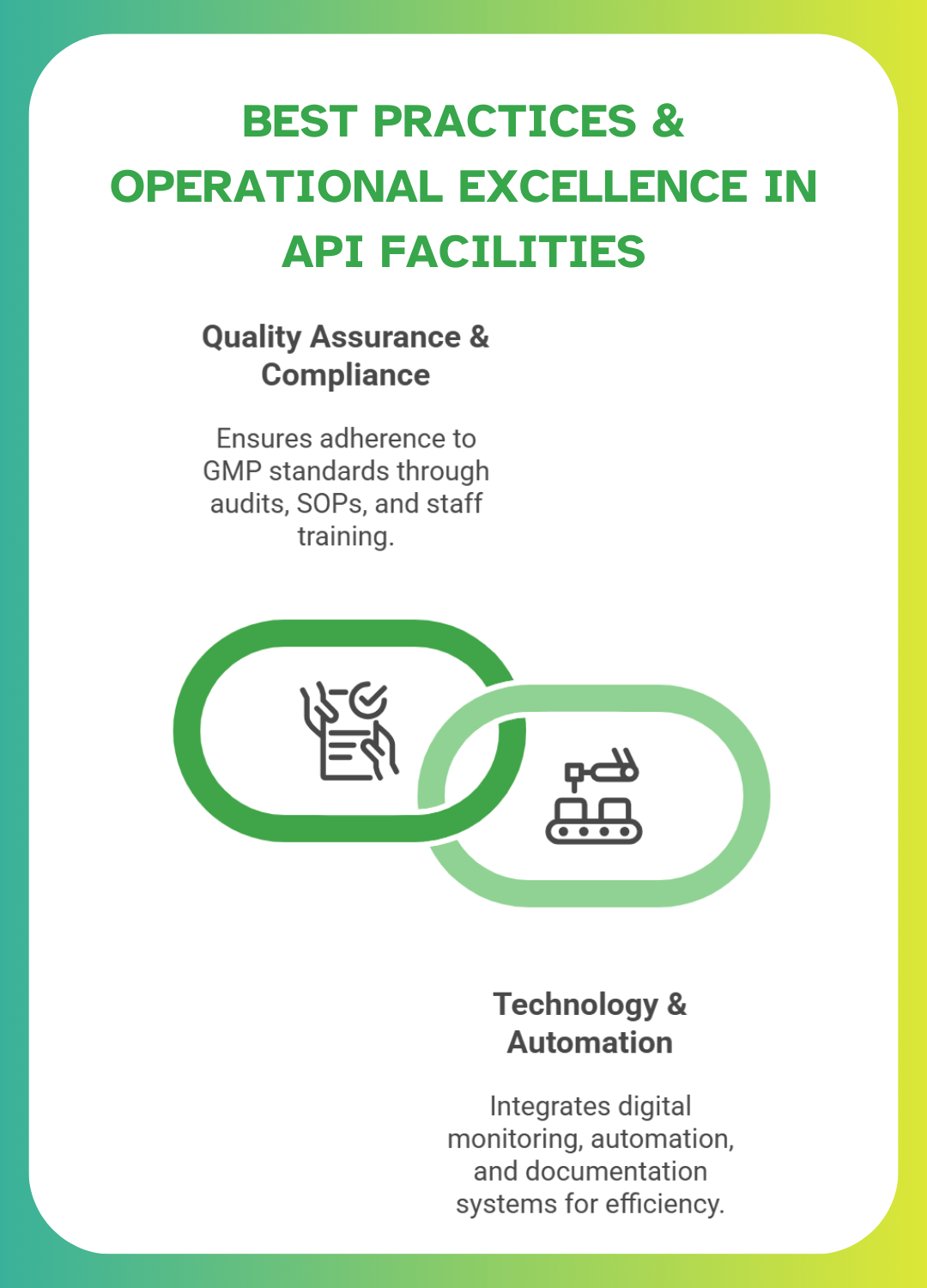
Quality Assurance & Compliance
Implementing robust quality assurance (QA) systems is critical for API facilities to ensure compliance with GMP standards. Key elements include:
- Regular Audits & Inspections: Routine internal audits and readiness for regulatory inspections help maintain compliance and identify potential non-conformities early.
- SOP Adherence & Documentation: Strict implementation of Standard Operating Procedures (SOPs) ensures process consistency. Accurate, traceable records maintain data integrity and compliance with ALCOA+ principles.
- Staff Training & Competency: Continuous training of personnel on GMP requirements, equipment operation, and process controls ensures staff remain proficient and compliant.
Technology & Automation
Integrating modern technologies can significantly improve operational efficiency and product consistency:
- Digital Monitoring & Process Analytics: Real-time monitoring of production processes reduces errors and ensures product quality. Predictive analytics help anticipate deviations before they impact output.
- Automation & Robotics: Automating repetitive tasks, from raw material handling to packaging, reduces human error and increases throughput.
- Integrated Documentation Systems: Automated recording and reporting systems support audit readiness and regulatory compliance.
Inotek: Your Strategic Partner in API Facility Projects in Russia
The complexities of establishing an API facility in Russia demand specialised expertise and compliance-focused execution. This is where Inotek steps in as your strategic partner. We don’t just manage construction timelines; we engineer fully compliant, GMP-aligned, and operationally efficient API facilities that meet global and local regulatory standards, including FDA, EMA, and EAEU GMP requirements.
Our comprehensive approach includes:
Regulatory Navigation: Ensuring full compliance with Russian and EAEU GMP standards, Roszdravnadzor approvals, and local environmental regulations to mitigate project risk.
Integrated Project Management: Coordinating design, construction, and commissioning phases to deliver facilities on time and within budget while maintaining operational efficiency.
Technology & Automation Integration: Implementing advanced automation, digital monitoring, and process optimisation to enhance production reliability and quality.
Quality & Operational Assurance: Establishing robust SOPs, QA systems, and validation protocols to ensure consistent GMP adherence and audit readiness.
By partnering with Inotek, pharma manufacturers have achieved:
- Faster facility commissioning timelines with streamlined construction and validation processes.
- Reduction in regulatory gaps and corrective actions through proactive compliance management.
- Enhanced operational efficiency and GMP alignment across complex API manufacturing setups.
While compliance forms the foundation, successful API facility projects must also address growing industry expectations around:
- Environmental sustainability and energy-efficient operations.
- Supply chain resilience for uninterrupted API production.
- Data integrity, digital compliance, and process transparency.
At Inotek, we ensure your API facility isn’t just audit-ready but engineered for long-term operational excellence and scalability.
Recognised among the Top 10 Pharma Turnkey Contractors & Project Consultants in 2022 & 2025, Inotek helps pharma leaders design, build, and upgrade facilities that meet the strictest GMP and sustainability standards.
📞 Connect with our experts today or visit www.inotek.co.in to schedule a consultation with Mr. Rohit Ochaney.
Whether you're planning a greenfield facility or optimising an existing setup, Inotek ensures your project is compliant, resilient, and future-proof.
FAQs
What are the regulatory requirements for establishing an API facility in Russia?
Approval from Roszdravnadzor, API registration, EAEU GMP certification, adherence to Russian and local GMP standards, and compliance with environmental and safety regulations are mandatory for API facility operations.
How long does it take to set up an API facility in Russia?
Setting up an API facility typically takes 2–4 years, including planning, feasibility studies, construction, equipment installation, validation, regulatory inspections, and commissioning for GMP-compliant operations.
What are the investment considerations for building an API facility in Russia?
Investment factors include land acquisition, construction, equipment procurement, staff training, regulatory compliance, operational costs, market potential, ROI analysis, and alignment with government incentives and Pharma 2030 strategy.
Which companies have successfully established API facilities in Russia?
Notable companies include ChemRar Group and Pharmasyntez, both operating GMP-compliant, full-cycle API facilities, contributing to domestic supply, import substitution, and advanced pharmaceutical manufacturing capabilities.