Publisher
Inotek
published at
November 26, 2025
Pharma EPC Metrics: Speed, Adaptability & Quality in CDMO Projects
Why do CDMO facilities miss timelines even when engineering and construction look “on track”?
In most cases, the issue isn’t effort; it’s the absence of the right pharma EPC metrics to control design, procurement, construction, and CQV.
CDMOs operate in GMP-sensitive environments where standard construction KPIs fail. Without the right EPC KPIs for pharma, teams face familiar problems: slow tech transfer, unstable HVAC systems, cleanroom delays, and unpredictable validation cycles.
This article gives you a clear, practical breakdown of the core EPC performance indicators every pharma or CDMO project needs, covering speed, adaptability, and quality. You’ll learn the exact CDMO project metrics that improve delivery timelines, strengthen compliance, reduce rework, and support right-first-time qualification.
If you want predictable facility delivery, stable batch-release timelines, and stronger audit readiness, start with the metrics outlined here.
Why EPC Metrics Matter in CDMO Projects
EPC metrics help CDMOs deliver projects on time by aligning engineering, construction, and CQV with expectations outlined in ISPE Baseline® Guides, which emphasize structured planning and traceable controls. They also support audit-readiness by ensuring facilities meet EU GMP requirements for design, cleaning, and error prevention. Early metric tracking exposes deviations, design gaps, and schedule drift, strengthening inspection outcomes. These metrics also support the lifecycle qualification model defined in ISPE’s C&Q Baseline Guide.
Unique Pressures in CDMO Engineering
CDMO engineering teams face fast molecule changes, short onboarding cycles, tight timelines, and frequent audits. EU GMP 6.1 requires facilities to address new manufacturing needs promptly while remaining compliant.
The ISPE Technology Transfer Guidance notes that layouts, utilities, equipment, and airflow systems often need rapid adaptation without compromising compliance. Accurate CDMO project metrics help quantify how effectively teams respond.
Annex 1 demands a consistent “state of control” for sterile areas, requiring cleanroom and utility stability even as production requirements shift. Tracking these metrics helps maintain that stability and prevent readiness gaps.
Without strong CDMO-focused EPC metrics, teams risk delays, validation setbacks, and reduced capacity - all of which impact client commitments.
How EPC Metrics Reduce Risk & Variability
GMP construction metrics reduce facility risk by ensuring accuracy in design, installation, and qualification readiness. ISPE’s C&Q Baseline Guide stresses verifying utilities, equipment, and cleanrooms against predefined acceptance criteria. Metrics ensure these checks happen systematically.
Tracking construction quality panel installation defects, HVAC tolerances, pressure cascade continuity, integration gaps, and supports contamination control requirements in EU GMP Annex 1.
Metrics also strengthen inspection outcomes by documenting control over critical facility elements, aligning with the lifecycle qualification requirements of EU GMP Annex 15.
Monitoring CQV cycle-time indicators, FAT/SAT closure, IQ/OQ duration, and corrective action cycles stabilises CQV and reduces schedule resets. This follows ISPE’s lifecycle qualification guidance.
Overall, EPC metrics help avoid rework, control deviations early, and create stronger evidence for regulatory reviews.
Aligning EPC Metrics With Annex 1 & ISO 14644
Annex 1 sets requirements for airflow direction, HEPA integrity, pressure differentials, recovery times, and particle limits. Tracking these parameters throughout construction helps ensure cleanrooms reach “state of control” before qualification.
ISO 14644-1 and 14644-2 define particle limits and testing frequencies for classification and monitoring. Metrics that track particle pass rate, pressure-cascade accuracy, and airflow performance ensure that cleanrooms meet these criteria.
Annex 1 also requires verification of cleanroom integrity using leak tests, airflow studies, and HEPA filter performance testing. Embedding these checks into EPC metrics ensures issues are corrected early.
ISO 14644-3 sets expectations for balanced airflow, recovery time, and stability, all of which are critical for contamination control. These become core EPC HVAC readiness metrics supporting a smooth path into CQV.
Aligning EPC metrics with Annex 1 and ISO 14644 helps ensure right-first-time qualification, stable cleanroom performance, and better audit outcomes.
Key Categories of Pharma EPC Metrics
Pharma EPC metrics fall under three core pillars- speed, adaptability, and quality. These three dimensions determine a CDMO’s ability to offer faster slot availability, stable batch-release timelines, and strong regulatory confidence. Each pillar supports a facility’s ability to remain audit-ready, commercially viable, and scientifically reliable, especially in fast-moving outsourcing environments where delays directly affect capacity utilisation and tech-transfer success.
Speed Metrics (Engineering, Procurement, Construction, CQV)
Speed is one of the most critical factors in CDMO competitiveness. The quicker an EPCM team can deliver engineering outputs, qualify suppliers, complete construction, and progress through CQV, the faster a CDMO can open capacity for new customers or expand existing production. In a market where time-to-market shapes commercial success, delays directly influence missed contracts, slower batch-release cycles, and regulatory deferrals.
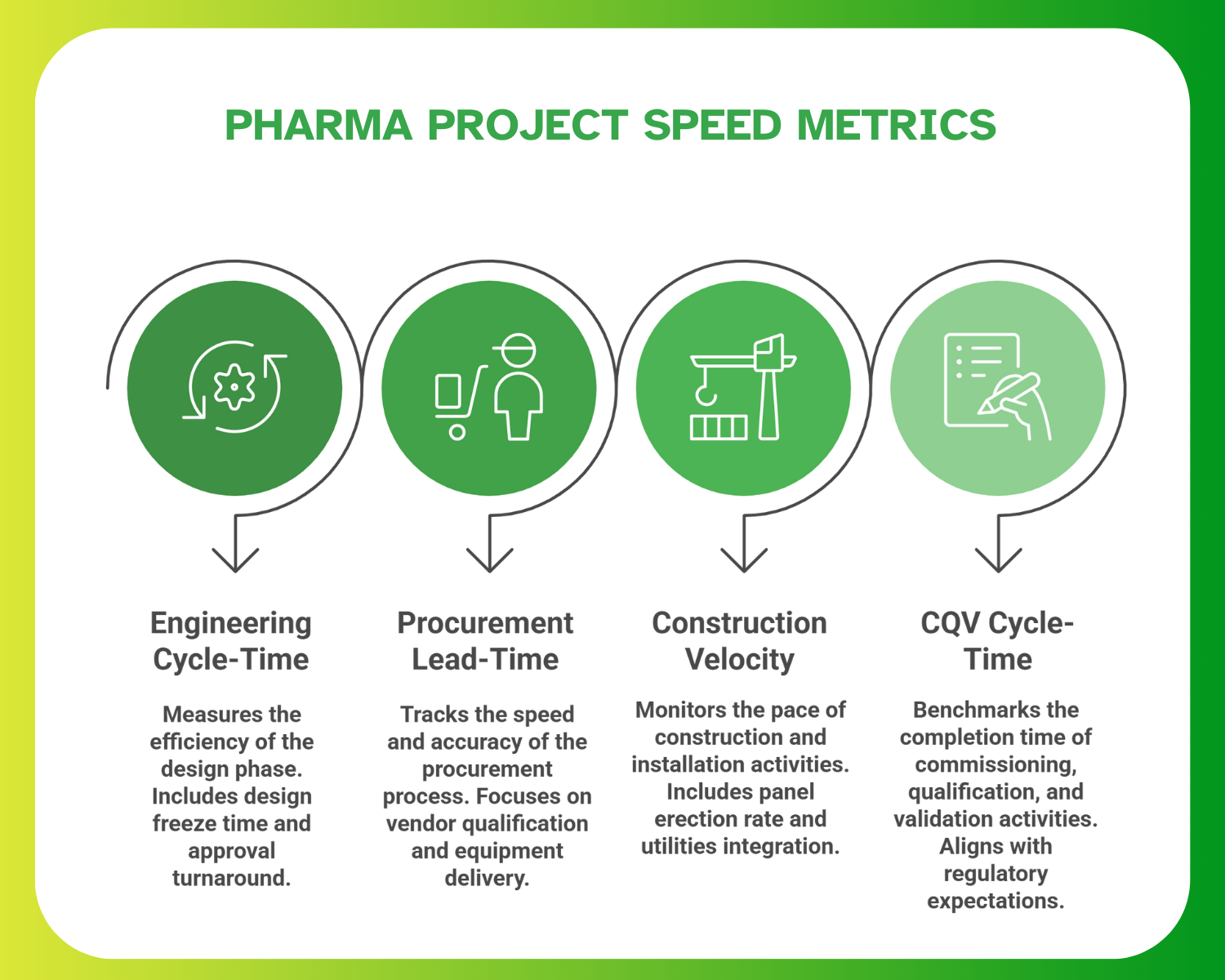
Engineering Cycle-Time KPIs
- Time to design freeze. A shorter design-freeze cycle reduces uncertainty across procurement and construction. When engineering teams finalise layouts, utility diagrams, and equipment lists earlier, downstream teams can begin planning with greater accuracy. Long or unstable design cycles often trigger late-stage changes and rework, extending CQV timelines.
- Review & approval turnaround times. Delays in drawing approvals, vendor datasheet reviews, or specification confirmation can disrupt the entire project sequence. Achieving greater than traditional cycles maintains higher alignment between engineering, procurement, and validation. This is especially important for CDMOs handling multiple client audits or concurrent tech-transfer projects.
- Design deviation closure rate. This KPI measures how effectively engineering teams resolve discrepancies between design intent and field execution. Faster closure rates indicate strong coordination across disciplines and reduce downstream deviation-driven rework. Slow closure creates compliance gaps that reappear during qualification.
Procurement Lead-Time KPIs
- Vendor qualification cycle: CDMOs rely on a wide network of GMP-critical suppliers. Tracking how fast procurement qualifies vendors, especially for equipment such as isolators, bioreactors, air-handling units, and pressure vessels, helps reduce early bottlenecks. Slow vendor qualification often becomes the first domino in a chain of delays.
- Long-lead equipment tracking accuracy. Items such as HVAC modules, filtration skids, cleanroom panels, and filling line components help global lead times. Tracking accuracy ensures procurement teams anticipate delays in construction or installation plans proactively. Missing this KPI is one of the top causes of schedule resets in pharma construction.
- PO-to-delivery adherence. This metric shows how consistently suppliers meet and promote predictable adherence, which means better predictability for installation timelines. Low adherence affects construction staging, utility routing, and CQV sequencing.
Construction & Installation Velocity KPIs
- Cleanroom panel erection rate. Completion of the cleanroom envelope determines when HVAC installation, pressure balancing, and particle testing can begin. Monitoring erection rates helps teams identify bottlenecks early and ensure structural integrity for ISO-classified spaces.
- Utilities integration speed Utility networks WFI, PW, HVAC, CDA, exhaust, steam, and electrical must reach partial completion before commissioning. Tracking integration rates helps detect routing conflicts, welding backlogs, or material shortages that may delay CQV.
- MEP installation progress vs baseline: Mechanical, electrical, and plumbing installations define whether a facility can progress into pre-commissioning. Tracking progress against baseline allows engineering leaders to intervene quickly when delays emerge.
CQV Cycle-Time Benchmarks
- IQ/OQ completion time: Shorter IQ/OQ cycles signal strong engineering accuracy and robust equipment readiness. Long cycles typically reflect design errors, poor installation quality, or documentation issues.
- PQ readiness cycles. This measures the number of cycles needed to demonstrate process stability. Fewer cycles reflect better alignment between equipment design, HVAC performance, and operational controls.
- Overall CQV cycle time (Annex 1 aligned). A predictable CQV duration indicates strong coordination between engineering, quality, operations, and validation. Annex 1 expectations around sterility, contamination control, and environmental monitoring heavily influence this length.
Adaptability Metrics (Flexibility, Change Agility, Modular Scalability)
Adaptability determines how well an EPCM team responds to changes during design, construction, or qualification. For CDMOs that frequently onboard new molecules, process changes, and client requirements, adaptability can determine whether commercial timelines are met or missed.
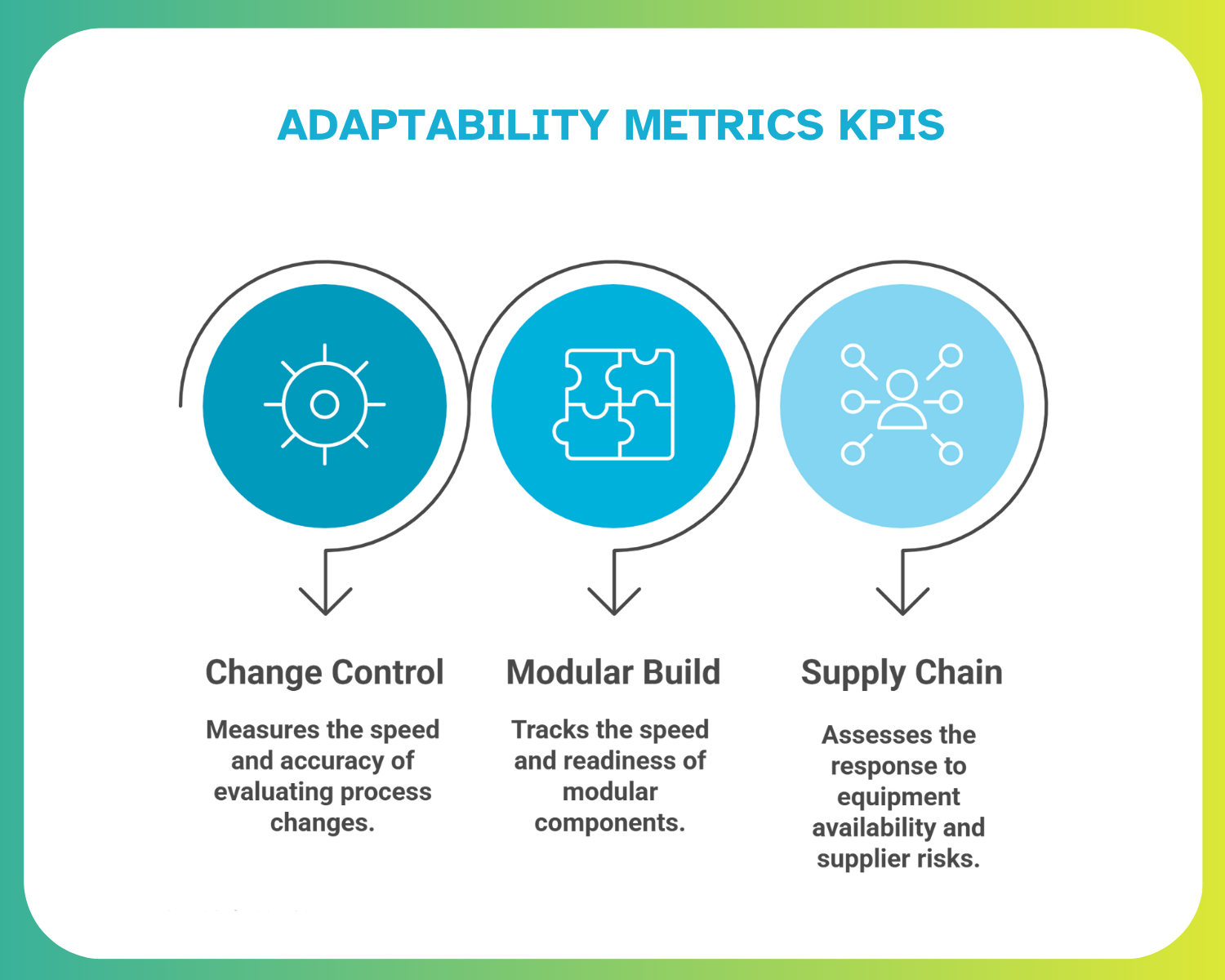
Change Control Responsiveness KPIs
- Time to evaluate late-stage process changes: DMOs often receive process inputs late from clients. Speed in evaluating these changes ensures that design, utilities, and documentation adjustments don’t affect compliance.
- Impact assessment accuracy: High accuracy reduces the risk of missing GMP-critical implications, such as contamination control or material compatibility. Poor assessment accuracy leads to deviations later in qualification.
- Re-engineering turnaround Measures how fast engineering teams can revise layouts, piping, automation logic, or HVAC requirements without creating execution risks. Faster turnarounds allow CDMOs to stay aligned with client demands.
Modular/Scalable Build KPIs
- Module fabrication speed. Prefabricated modules shorten installation timelines and reduce onsite variability. Faster module fabrication supports aggressive CDMO scale-up plans.
- Plug-and-play utility readiness Tracks how quickly modules connect to existing systems. Strong performance here significantly reduces commissioning time.
- Reconfiguration time for new products. Short reconfiguration windows reflect facility flexibility, a key differentiator for CDMOs handling diverse client portfolios.
Supply Chain Adaptability KPIs
- Response to volatile pharma-grade equipment availability: Global disruptions often affect equipment availability. Tracking response times helps procurement mitigate risk before schedules are impacted.
- Supplier risk scoring: A structured risk framework improves sourcing decisions and prevents qualification delays.
- Alternate sourcing activation time. Faster activation of backup suppliers reduces downtime and protects construction progress.
Quality Metrics (Compliance, Validation, Performance Reliability)
Quality metrics determine whether the facility meets GMP expectations, successfully qualifies, and remains resilient during regulatory inspections. These KPIs reflect the reliability of EPCM execution in building a compliant, long-term-ready plant.
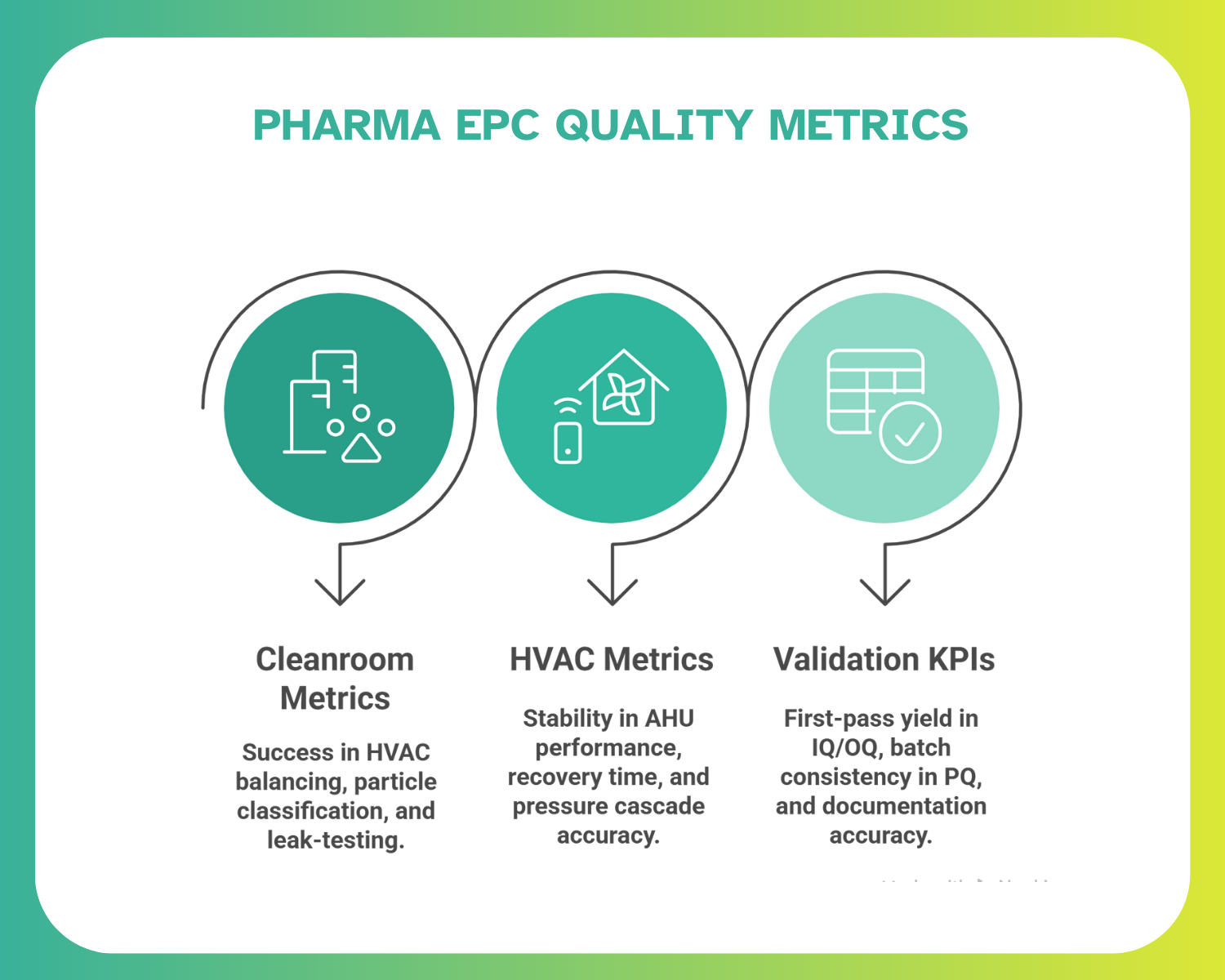
Cleanroom Quality & Acceptance Metrics
- HVAC balancing success. Proper airflow balancing ensures pressure cascades and directional airflow meet ISO classification requirements. High balancing success reduces delays in cleanroom qualification.
- Particle classification pass rate ISO 14644 requires specific particle-count thresholds. High pass rates signal strong cleanroom construction quality and envelope integrity.
- Cleanroom envelope leak-test success. Leak testing helps detect integrity failures in panels, doors, or joints, protecting sterility and supporting easier CQV.
HVAC Performance & Readiness Metrics
- AHU performance stability. Stable air-handling performance ensures environmental control, minimising variations that can lead to deviations during PQ.
- Recovery time after disturbances. This measures how fast cleanrooms return to steady state after door openings or personnel movement. Faster recovery correlates with stronger contamination control.
- Pressure cascade accuracy. Proper pressure gradients between cleanroom zones prevent cross-contamination and are essential for Annex 1 compliance.
Qualification & Validation Pass-Rate KPIs
- IQ/OQ first-pass yield. High first-pass rates show strong installation quality and correct interpretation of URS/DS/FS requirements. Low first-pass yields often indicate engineering or documentation issues.
- PQ batch consistency. PQ success demonstrates that equipment, HVAC systems, utilities, and processes operate within defined limits. Consistency reduces regulatory scrutiny and accelerates commercial readiness.
- Documentation right-first-time score: High documentation accuracy reflects strong quality systems and reduces delays during audits or validation reviews.
How EPC Delays Impact CDMO Output & Commercialisation Timelines
EPC delays create measurable downtime across tech transfer, batch release, and operational readiness. Even small delays disrupt capacity commitments, slow revenue generation, and increase audit exposure. They also affect a CDMO’s ability to onboard new clients quickly or deliver existing programs within contracted timelines, directly influencing commercial credibility and regulatory confidence.
Tech Transfer Delays & Regulatory Slippage
Tech transfer timelines depend on EPC readiness. When engineering, procurement, or construction tasks slip, CDMOs cannot receive new processes, run engineering batches, or complete validation. This slows scale-up, troubleshooting, and process fit activities.
Delays in handover impact equipment readiness, cleanroom qualification, HVAC stabilisation, and utility commissioning prerequisites for process transfer. Without a qualified facility, CDMOs cannot execute PPQ batches or initiate regulatory validation, delaying dossier submissions and commercialisation.
Regulatory agencies expect clear proof of process fit and facility control. EPC delays slow the generation of this evidence, trigger additional regulatory queries, and may force deferrals to later filing cycles. This extends approval timelines and pushes revenue generation further out.
Overall, EPC delays cascade into longer tech-transfer timelines, delayed licensing submissions, and extended market-entry barriers for both CDMOs and sponsors.
Line Utilisation Losses & Batch Release Delays
When EPC handovers slip, CDMOs lose available production hours because new cleanrooms, utilities, or production areas cannot begin media fills, engineering runs, or GMP batches. This reduces equipment utilisation and disrupts capacity commitments.
Batch release pathways are also slow. Without completed CQV, quality teams cannot perform environmental monitoring qualification, aseptic simulations, or PQ batches essential for batch certification. This extends release cycles and creates workload backlogs for QA release teams.
CDMOs running multiple programs face additional strain: delayed lines cause PPQ scheduling conflicts, overlapping validation slots, and missed contracted delivery agreements. They also reduce flexibility to prioritize urgent client programs or new tech-transfer opportunities.
Lower utilisation ultimately reduces manufacturing throughput, billable volume, and the ability to offer added capacity to new clients, directly affecting competitiveness and revenue.
Cost Escalation & Deviation Multipliers
EPC delays increase project cost through extended labour, repeated mobilisations, and additional contractor hours. Deviation-driven costs escalate even further: each deviation requires investigation, corrective actions, and retesting, adding significant resource load.
In Annex 1–regulated sterile areas, deviations carry a higher impact due to strict contamination-control requirements. Root-cause investigations and retesting, such as airflow visualisation, HEPA leak tests, and particle requalification, extend qualification timelines and multiply costs.
Deviation multipliers also slow CQV. Errors that pass into commissioning require repeated IQ/OQ cycles, new documentation, and additional PQ sampling, creating a chain reaction: more deviations → longer CQV → later handover → higher project cost.
Cost escalation also reduces a CDMO’s pricing flexibility and limits capital for future expansion, weakening long-term competitiveness.
How Inotek Strengthens Project Outcomes Using Advanced Pharma EPC Metrics
The rising complexity of pharma EPC metrics, CDMO project timelines, and GMP-sensitive construction demands a partner who understands engineering precision, validation maturity, and regulatory expectations. This is where Inotek steps in as your strategic EPCM partner.
We don’t just execute EPC activities; we build metric-driven, risk-controlled, Annex 1-aligned EPC frameworks that ensure every facility meets global regulatory standards, including ISO 14644, FDA, EMA, and CDSCO. Our approach ensures predictable delivery, faster CQV cycles, and right-first-time cleanroom performance for CDMOs and pharma manufacturers.
Key Service Pillars
Our comprehensive approach includes:
1. Metric-Driven Engineering & Design Freeze Control
We apply structured EPC performance indicators, design-freeze KPIs, engineering approval metrics, and deviation-closure benchmarks to minimize late-stage rework and accelerate facility readiness.
2. Procurement Intelligence for Long-Lead & GMP-Critical Equipment
We track procurement lead-time KPIs, vendor qualification cycles, long-lead equipment timelines, and PO-to-delivery adherence to prevent delays and strengthen supply-chain predictability for CDMO projects.
3. Cleanroom Construction Metrics & HVAC Readiness Framework
Our cleanroom and HVAC delivery model uses ISO 14644 metrics, Annex 1 contamination-control KPIs, HVAC performance indicators, leak-test pass rates, and construction velocity KPIs to achieve right-first-time installation.
4. CQV Acceleration Using Validation-Led EPC Metrics
We monitor IQ/OQ/PQ pass-rate KPIs, CQV cycle-time benchmarks, documentation accuracy scores, and readiness audits to shorten validation cycles and reduce regulatory risk.
5. Real-Time Digital Dashboards & EPC Monitoring Systems
We deploy live dashboards, digital oversight systems, and integrated progress monitoring tools to ensure transparency, early deviation detection, and metric-driven decision-making.
Predefined Outcomes for Pharma & CDMO Clients
By partnering with Inotek, pharma manufacturers achieve:
- Faster engineering and construction timelines through structured EPC performance metrics
- Higher CQV first-pass success rates, reducing remediation and audit findings
- Reduced Annex 1 compliance gaps, driven by robust cleanroom and HVAC readiness KPIs
- Stable batch-release scheduling due to predictable EPC-to-CQV transitions
- Greater CDMO capacity utilisation, supported by on-time facility handover
Beyond achieving compliance and project delivery, modern CDMO and pharma facilities must address emerging industry priorities, including:
- Energy-efficient HVAC design and sustainability-aligned facility planning
- Real-time supply-chain visibility and long-lead predictive analytics
- Robust data integrity, digital validation, and Annex 1 contamination-control expectations
- Lifecycle performance metrics to reduce operational cost and downtime
At Inotek, we ensure your facility is not only audit-ready but engineered for long-term performance, scalability, and global commercial readiness using EPC metrics as the backbone of decision-making.
Recognized among the Top 10 Pharma Turnkey Contractors & Project Consultants in 2022 & 2025, Inotek helps leading pharma and CDMO organisations design, build, and scale facilities using advanced pharma EPC metrics, validation-led engineering, and strong compliance frameworks.
📞 Speak to our EPCM experts today or visit www.inotek.co.in to schedule a consultation with Mr. Rohit Ochaney.
Whether you're building a new CDMO facility or upgrading cleanrooms, HVAC systems, or sterile areas, Inotek ensures your project is compliant, resilient, and ready for global audits.
FAQs
What are the most important EPC metrics for pharma and CDMO projects?
The most important pharma EPC metrics include design-freeze accuracy, procurement lead-time KPIs, cleanroom construction quality indicators, HVAC readiness metrics, and CQV cycle-time benchmarks. These EPC KPIs ensure predictable delivery, strong compliance with Annex 1 and ISO 14644, and faster commercial readiness in CDMO environments.
Why do CDMO facilities need specialized EPC KPIs instead of standard construction metrics?
CDMO facilities operate in GMP-sensitive environments where sterility, HVAC stability, documentation accuracy, and validation timelines directly affect batch release. Standard construction KPIs cannot capture these risks. Specialized pharma EPC metrics provide precise control over compliance, qualification readiness, and audit expectations.
How do EPC delays impact CDMO capacity and commercial timelines?
EPC delays slow tech transfer, extend CQV duration, reduce line utilisation, and push batch-release dates. These issues cause revenue loss, missed onboarding windows, and delayed regulatory submissions. Strong EPC KPIs help CDMOs protect capacity commitments and maintain predictable commercial timelines.
How do Annex 1 and ISO 14644 influence pharma EPC metrics?
Annex 1 and ISO 14644 define airflow control, particle limits, pressure differentials, and environmental stability. EPC metrics aligned to these standards track cleanroom integrity, HVAC performance, contamination-control readiness, and qualification stability, supporting right-first-time approvals and stronger audit outcomes.
What speed-related EPC metrics help CDMOs reduce project delays?
Useful speed metrics include engineering approval turnaround time, vendor qualification cycle time, long-lead equipment tracking accuracy, cleanroom erection rate, and IQ/OQ completion cycles. Tracking these KPIs helps CDMOs prevent schedule drift and open capacity faster for new or expanding programs.
How can CDMOs improve EPC adaptability during molecule changes or tech-transfer updates?
Adaptability improves when CDMOs track change-control responsiveness, impact-assessment accuracy, re-engineering turnaround speed, modular build readiness, and supply-chain agility. These EPC adaptability metrics help teams respond quickly to molecule changes without compromising GMP compliance or validation timelines.