Publisher
India Pharma Outlook
published at
July 9, 2025
Jordan’s Pharma Export Boom: Engineering Audit-Ready Facilities for EMV 2033
Can Jordan’s pharma infrastructure keep pace with its export goals?
With exports growing 14.8% in 2024 and EMV 2033 targeting JD 2.1 billion in annual pharma exports, Jordan’s pharmaceutical sector is on a steep upward trajectory. But as demand accelerates, many existing and upcoming facilities face a common hurdle: they’re not designed to meet the compliance, scalability, and audit readiness required for global market access.
Today, success is no longer about just building fast—it’s about building smart. For QA heads, CQV specialists, and engineering leaders, that means:
- Designing facilities that are GMP-compliant from Day 1—not retrofitted later
- Embedding validation into every stage of construction, from layout to commissioning
- Choosing cleanroom materials and systems based on zone requirements and URS, not legacy assumptions
- Aligning with WHO, EMA, and JFDA expectations to support global inspections and regulated market entry
In this article, we examine how Inotek’s execution of a new Oral Solid Dosage (OSD) facility in Jordan offers a scalable model for this next-gen facility design. You’ll learn how engineering-led planning, modular systems, and early-stage validation integration can transform national ambition into audit-ready, export-capable infrastructure.
Jordan’s Pharma Growth: A Sector Ready for Scale, Compliance, and Global Access
Jordan is no longer just an emerging player in the pharmaceutical industry—it’s evolving into a regional anchor. In 2024, pharma exports rose by 14.8% to JD 611 million despite regional instability and supply chain headwinds. This isn’t a one-time surge—it’s a sign of systemic resilience and a bold national commitment under the Economic Modernisation Vision (EMV).
EMV 2033: Ambitious Targets That Demand Engineering Precision
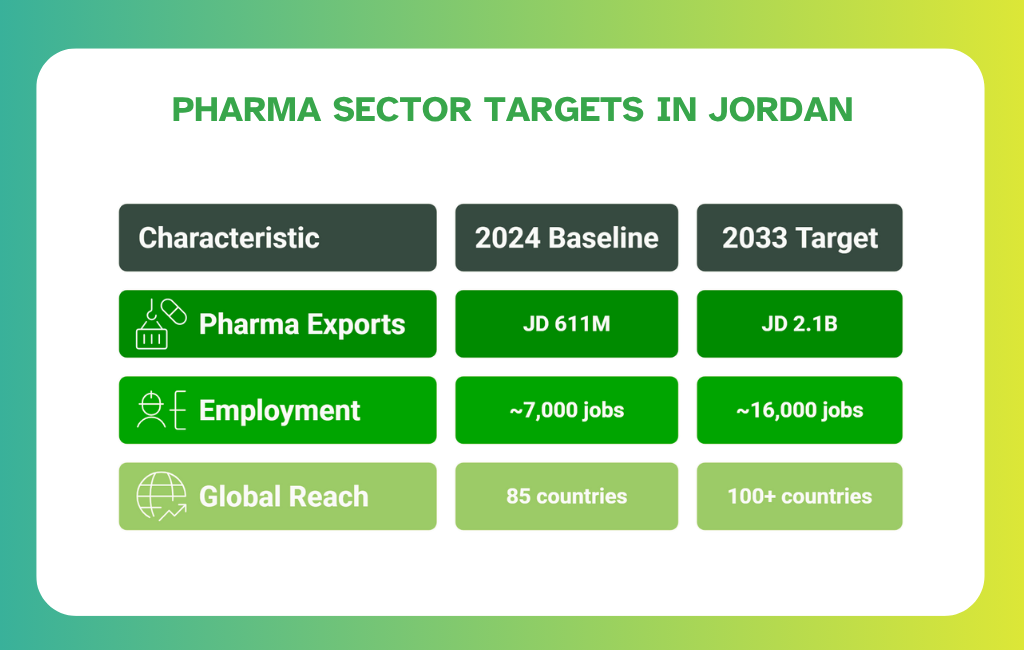
EMV outlines measurable goals that will reshape the pharma landscape:
- JD 2.1 billion in annual pharma exports by 2033
- 16,000+ direct jobs, doubling the current workforce
- JD 1.1 billion in targeted pharma manufacturing investments
These aren’t just macroeconomic ambitions—they signal new operational realities for QA leaders, CQV specialists, and engineering directors. Achieving EMV targets will require:
- Audit-readiness from Day 1 aligned with WHO, EMA, and JFDA GMP frameworks
- Scalability to accommodate future product lines and capacity expansions
- Export-enabling compliance that supports entry into regulated markets like the EU, GCC, and the US
Sector Strengths Driving Global Reach
Jordan’s pharmaceutical ecosystem is already punching above its weight:
- 80% of domestically manufactured medicines are exported
- Products reach 85+ international markets, including the US, Saudi Arabia, UAE, and Iraq
- Home to 27 licensed facilities, producing everything from tablets and capsules to injectables
- Over 7,000 jobs, with 35% female workforce participation—showcasing inclusive growth
Pharma manufacturers in Jordan are also expanding into new drug categories and proactively aligning with WHO and EU GMP standards, reinforcing their reputation as compliance-ready and innovation-driven.
Why This Matters for Facility Design
With this momentum, facility builds can no longer rely on outdated assumptions or reactive compliance strategies. To stay globally competitive, projects must integrate:
- GMP validation in the layout and material choices
- Modular construction systems that enable faster timelines without compromising quality
- Application-specific engineering decisions rooted in risk and regulatory strategy
That’s exactly what Inotek is delivering on the ground—executing a new Oral Solid Dosage (OSD) facility for tablets and capsules in Jordan. It’s more than a construction project; it’s a blueprint for EMV-era facility execution: scalable, audit-ready, and aligned with international inspection expectations.
How Is EMV 2033 Supporting the Pharma Sector Expansion?
The Economic Modernisation Vision (2022–2033) isn’t just an aspirational policy—it’s a binding framework guiding the sector toward measurable success.
EMV Pharma Sector Goals by 2033:
- Achieve JD 2.1 billion in pharma exports (up from JD 200M in 2021)
- Create 16,000+ pharma jobs (more than doubling the 2024 figure)
- Sustain a ~20.3% CAGR in pharma export growth
EMV-Driven Support Measures:
- Regulatory harmonization via the Jordan Food and Drug Administration (JFDA), aligned with the WHO, EMA, and GCC GMP frameworks
- Incentives for innovation and intellectual property, boosting access to patent data, and encouraging NCE (new chemical entity) research
- Fast-track GMP registration procedures, shortening time-to-approval for local drug manufacturers
Implications for Engineering and QA Leaders
This growth will not be achieved solely through commercial strategies. For engineering, QA/QC, and validation teams, it signals a wave of facility expansions, GMP upgrades, and cleanroom design overhauls. The bar for compliance and scalability is rising, and only those facilities built to global inspection standards will be ready to support Jordan’s export ambitions.
Engineering Compliance Under Pressure: Validation in Fast-Track Builds
As Jordan’s pharmaceutical sector pushes toward EMV 2033 targets, the urgency to build facilities more quickly is intensifying. But speed without compliance is a liability. Regulatory expectations—especially for export-focused plants—are increasing, and global audit readiness is no longer a luxury; it has become a baseline requirement.
In this environment, validation oversights, poor material choices, or missing documentation can trigger costly rework and inspection delays. For engineering and CQV teams, the mandate is clear: engineer compliance from Day 1, not after construction ends.
Key Validation Focus Areas: From Global GMP to JFDA Expectations
With EU GMP Annex 1 (2022) and WHO TRS 1019 now shaping international standards, validation is no longer a phase—it’s a lifecycle approach. Here’s where regulatory scrutiny is most intense:
- Contamination Control Strategy (CCS)
Every facility must define a CCS that addresses process flows, airlocks, HVAC zoning, and equipment layout, anchored in risk-based logic. - Material Qualification & URS Justification
Cleanroom walls, ceilings, and flooring must meet defined specs for cleanability, particulate control, and durability, and every selection must be traced back to the User Requirement Specification (URS). - Design-to-Validation Traceability
WHO TRS 1019 requires full lifecycle oversight: decisions made during design must connect directly to IQ/OQ/PQ protocols.
In Jordan, the Jordan Food and Drug Administration (JFDA) is enforcing these global standards rigorously. Recent inspections have scrutinized the following:
- Installation logs confirming corner details and panel sealing
- Cleaning validation data to assess surface durability across sanitization cycles
- As-built documentation and equipment calibration records mapped back to the original URS
Failing to present validation-aligned evidence during inspections—even in non-sterile Oral Solid Dosage (OSD) sites—can halt approvals or prompt costly revalidation.
In Jordan’s fast-paced build environment, validation can’t be a checkbox—it must be a design principle.
By embedding compliance checkpoints into every phase—from layout planning to utility installation—engineering teams can meet EMV timelines without compromising audit success.
Cleanroom Panels: Why HPL Isn’t Always the Smart Choice
In many emerging markets, High-Pressure Laminate (HPL) panels are treated as the default choice for cleanroom wall systems. They’re chemically resistant, widely used, and familiar. However, defaulting to HPL without a zone-specific justification or URS often results in long-term risks, especially in export-oriented facilities.
Why HPL Can Backfire Without Context
- High Maintenance Risk
HPL is prone to edge chipping and joint delamination if not flawlessly installed, leading to repair cycles and downtime over time. - Fire Safety Gaps
Unless specially treated, HPL is combustible. In solvent storage zones or fire-rated areas, rock wool panels are better aligned with passive fire code requirements. - Installation Inefficiencies
HPL is rigid and harder to modify on-site, increasing installation timelines and the likelihood of non-documented field changes—a GMP red flag.
Smarter Alternative: Modular Sandwich Panels Based on URS
Materials like PUF, Rockwool, and aluminum honeycomb cores offer:
- Faster modular installation
- Zone-aligned properties (thermal, fire, acoustic, cleanability)
- Better traceability and compliance when selected based on URS
But these must be chosen based on application, not familiarity.
Key Takeaway
In fast-paced builds like Jordan’s EMV-aligned facilities, guessing on materials isn’t just inefficient—it’s risky.
Validation needs must be embedded into every panel decision.
By linking material specifications to URS, fire codes, and cleaning validations from the outset, engineering teams can eliminate rework, reduce lifecycle costs, and meet GMP expectations from Day 1.
Inotek’s OSD Facility in Jordan: An Engineering Case in Point
Turning growth targets into GMP-certified reality is no small feat, especially in a fast-evolving regulatory landscape like Jordan’s. That’s exactly the challenge Inotek took on with the design and execution of a new Oral Solid Dosage (OSD) facility for producing tablets and capsules. The goal is to deliver a scalable, audit-ready plant that meets the compliance benchmarks of the WHO, EMA, and JFDA while remaining cost-effective and adaptable to future expansion.
This project serves as a real-world blueprint for what successful pharma facility expansion looks like when engineering, QA, and validation teams work as an integrated force.
Key Project Milestones
Design Engineering Completed
Inotek adopted a modular, risk-based design approach that aligned with EU GMP Annex 1 and WHO TRS 1019. The facility layout supported unidirectional material flow, clear zoning, and contamination control principles, even though the product type was non-sterile.
On-Site Execution Underway
The project moved seamlessly from concept to construction, with commissioning and qualification (C&Q) workflows embedded from the start. Utility systems, HVAC, granulation lines, and packaging areas are being installed with validation-aligned URS traceability and pre-defined acceptance criteria.
Client Education on Material Strategy
A common misconception initially constrained the project: the belief that High-Pressure Laminate (HPL) panels were the only acceptable option for cleanroom wall partitions. Inotek’s engineering team dismantled this assumption with data-driven clarity.
A Misconception Debunked: HPL Isn’t the Only Viable Panel
Many regional projects default to HPL-faced sandwich panels under the assumption that regulators expect them to do so. However, Inotek demonstrated that smart material selection—aligned with application needs and documented URS—is far more important than brand or familiarity.
When selecting wall and ceiling panel types for pharmaceutical facilities, each option offers specific strengths based on your application—whether it's cleanability, fire resistance, thermal performance, or structural rigidity. Here's a breakdown of the key panel types and their ideal uses:
- PUF Core Panels
These panels provide excellent thermal insulation and support fast, modular installation. They are especially suitable for large, climate-controlled production or storage areas due to their high energy efficiency. - Rockwool Core Panels
Known for their fire resistance and acoustic insulation properties, Rockwool panels are ideal for inter-zone barriers and fire-rated partitions within a facility. - Honeycomb Panels
With high rigidity and minimal weight, honeycomb panels are best suited for applications such as walkable ceilings and areas requiring large structural spans without added load. - Powder-Coated Steel Panels
These panels offer a durable, cleanable, and antimicrobial finish, making them an ideal choice for processing zones where hygiene and frequent cleaning are crucial.
These decisions were guided by factors such as:
- Area classification (e.g., Grade D processing vs. support corridors)
- Fire performance and compliance with local building codes
- Structural rigidity for heavy-equipment zones
- Cleanability and longevity under repeated sanitization
By adopting a fit-for-purpose material strategy, Inotek helped the client avoid costly over-engineering while ensuring full compliance with WHO GMP and local JFDA inspection protocols. The result is a facility that is functionally optimized, cost-efficient, and globally auditable, with zero compromise on long-term validation readiness.
Design Discipline: The 5-Step Playbook for EMV-Ready GMP Facilities
In high-growth markets like Jordan, where timelines are tight and global inspections are inevitable, design decisions become regulatory outcomes.
Drawing from Inotek’s execution of an Oral Solid Dosage (OSD) facility in Jordan, here’s a proven framework for QA, CQV, and engineering teams building EMV-ready pharma plants.
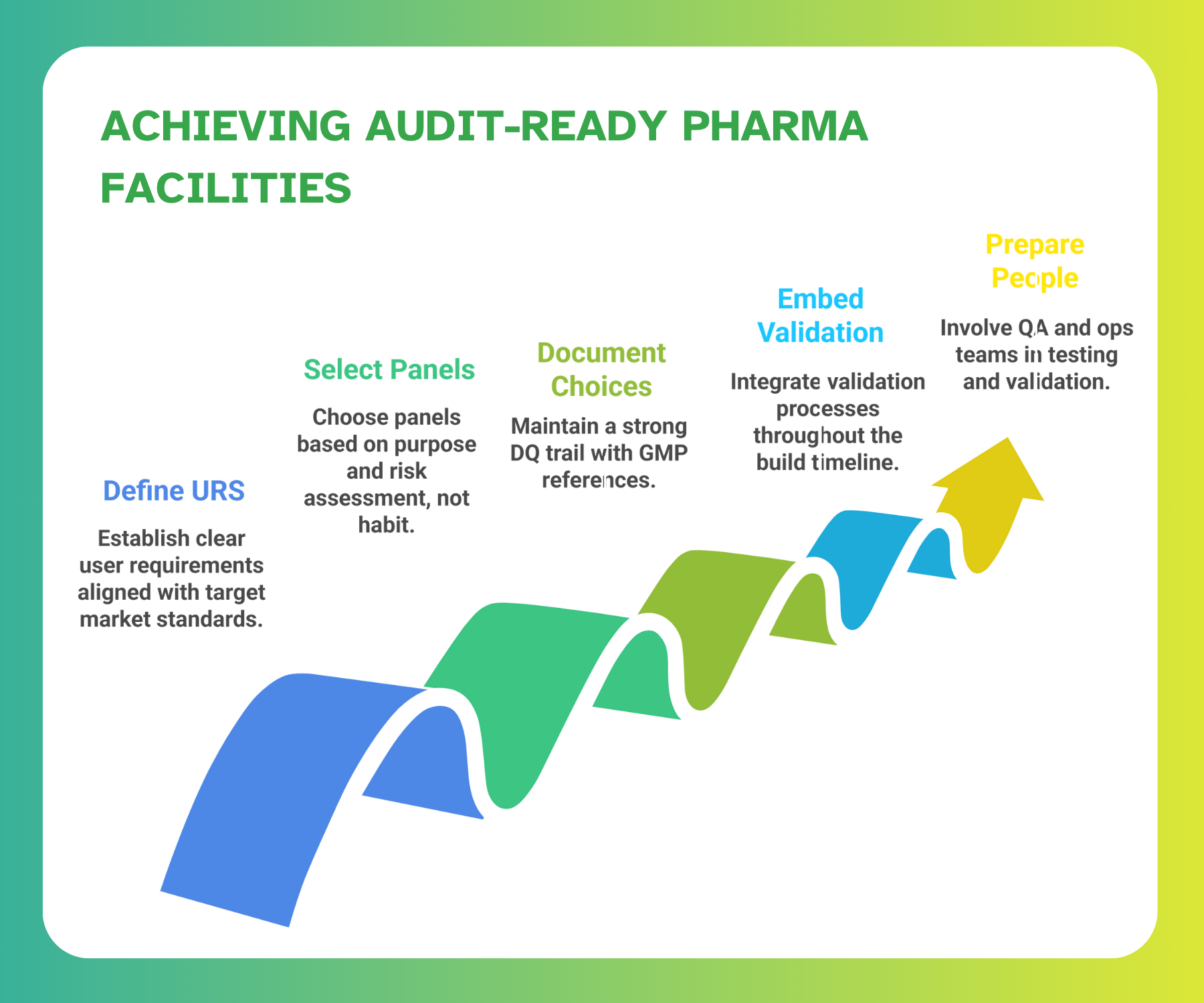
5 Design Principles for Audit-Ready Pharma Facilities
1. Define the URS Early—And Anchor Everything to It
Your User Requirement Specification must align with your most demanding target market—whether it is the WHO, EMA, or GCC. This ensures every decision, from HVAC zoning to cleanroom class, is traceable and defensible.
2. Let Purpose Guide Panel Selection—Not Habit
HPL isn’t a GMP default. Choose based on:
- PUF panels → for thermal insulation
- Rockwool → for fire-rated zones
- Honeycomb → for structural span/ceiling rigidity
Let the URS and risk assessment drive choices, not legacy preferences.
3. Document Every Design Choice with Risk-Based Justification
Regulators will ask, “Why this layout, material, or system?”
- Maintain a strong Design Qualification (DQ) trail
- Cite GMP references: Annex 1, WHO TRS 1019, JFDA
- Show alternatives considered
4. Embed Validation into the Build Timeline (IQ/OQ/PQ)
Validation isn’t a phase—it’s a parallel process.
- IQ during installation
- OQ before system handover
- PQ pre-launch
This prevents rework and accelerates the regulatory approval process.
5. Prepare Your People, Not Just Your Plant
Audit readiness = team readiness.
Involve QA and ops during:
- Factory Acceptance Testing (FAT)
- Cleaning validation and SOP drafting
- Final walkthroughs
Result: your teams can confidently defend design decisions during inspections.
Conclusion: Building the Future with Precision
Jordan’s pharmaceutical sector is no longer at a crossroads—it’s on a fast track. With EMV targets pushing toward JD 2.1 billion in exports and 100+ international markets in scope, the pressure to deliver isn’t just on regulators or policymakers—it’s squarely on the shoulders of QA leaders, validation teams, and engineering heads.
But rapid growth without rigour invites risk.
As facility expansions accelerate, success will come to those who treat compliance not as a mere checkpoint, but as a fundamental design principle. This means embedding audit-readiness, cleanroom strategy, and validation documentation into every blueprint and bill of materials, from URS to commissioning.
Inotek’s engagement on the ground in Jordan proves that this is not just a theory. From challenging outdated HPL myths to aligning modular panel systems with international GMP, the project showcases how engineering precision, regulatory clarity, and fit-for-purpose design can converge to create facilities that scale with confidence—and pass audits without panic.
This isn’t about building fast. It’s about building smart.
How Inotek is Powering Jordan’s EMV Vision with GMP Engineered Facility Design
The complexities of designing audit-ready pharma facilities at EMV speed demand specialized expertise and compliance-focused execution.
This is where Inotek steps in as your strategic partner. We don’t just build pharma infrastructure—we engineer GMP validation, regulatory traceability, and future scalability into every facility we deliver, aligning with global standards such as WHO GMP, EMA Annex 1, and FDA protocols.
Our comprehensive approach includes:
URS-Driven Facility Design: Every layout, utility specification, and cleanroom class is anchored to a market-aligned User Requirement Specification (URS), ensuring traceability and validation readiness from day one.
- Modular Cleanroom Systems: We deploy fit-for-purpose panel systems (PUF, Rockwool, honeycomb) based on zone function, cleanability, and fire code requirements, thereby avoiding costly rework.
- Integrated C&Q Frameworks: IQ/OQ/PQ protocols are embedded into the construction timeline to ensure a seamless transition from build to regulatory approval.
- Material & Risk Qualification: Every design decision—from flooring to HVAC—is backed by risk assessments, regulatory references, and validation logs.
- Client Training & Audit Prep: From SOP development to on-site walkthroughs, we train QA and maintenance teams to defend design decisions during inspections.
How Inotek Helped Deliver Jordan’s EMV Vision
Inotek recently designed and executed a new Oral Solid Dosage (OSD) facility in Jordan, tailored to meet the standards of the WHO, EMA, and JFDA. Here’s how we added value:
- Debunked the misconception that HPL was the only acceptable panel—replaced it with zone-specific, risk-assessed modular systems
- Embedded validation strategy into the construction timeline—ensuring traceable, audit-aligned IQ/OQ/PQ protocols
- Enabled faster C&Q execution with factory QC documentation, field installation logs, and SOP co-development
- Delivered a facility that is scalable, inspection-ready, and engineered to support regulated market exports from Day 1
This project now stands as a blueprint for other EMV-aligned facilities across Jordan’s expanding pharma sector.
More Than Compliance—Built for Jordan’s Pharma Future
While GMP compliance is foundational, success under EMV 2033 also depends on anticipating broader challenges like:
- Sustainability in facility materials and HVAC energy loads
- Supply chain alignment with fast-track GMP approvals
- Digital validation systems and documentation traceability
At Inotek, we don’t just ensure your facility passes audits—we engineer it to scale, adapt, and thrive in tomorrow’s pharma landscape.
Let’s Build EMV-Aligned Facilities—Right the First Time
Recognized among the Top 10 Pharma Turnkey Contractors & Project Consultants in 2022 & 2025, Inotek helps pharma leaders design, build, and upgrade world-class facilities that meet the highest GMP and sustainability standards.
📞 Connect with our experts today or visitwww.inotek.co.in to schedule a consultation with Mr. Rohit Ochaney.
Whether you're planning a greenfield facility or retrofitting for EMV compliance, Inotek ensures your project is compliant, resilient, and future-ready.
FAQs
What are Jordan’s EMV 2033 targets for pharmaceutical exports?
Jordan’s Economic Modernisation Vision (EMV) aims to increase pharmaceutical exports to JD 2.1 billion by 2033, double sector employment to over 16,000, and position Jordan as a regional hub for high-quality, GMP-compliant pharmaceutical manufacturing and exports.
Why is cleanroom design critical for pharma facility compliance?
Cleanroom design has a direct impact on contamination control, audit readiness, and operational scalability. WHO and EU GMP guidelines require cleanroom materials, airflow, and zoning to be validated from the design stage to ensure regulatory compliance and long-term facility integrity.
What’s wrong with defaulting to HPL panels in pharma builds?
HPL panels, while familiar, may not always meet fire safety, durability, or cleanability standards for all zones. Alternative panels, such as PUF, Rockwool, or powder-coated steel, often offer better compliance, easier validation, and lower lifecycle costs when chosen based on URS.
How does Inotek support validation in fast-paced pharma projects?
Inotek integrates validation into every phase—design, procurement, and construction. From URS drafting and risk assessment to C&Q execution and FAT training, the team ensures facilities are audit-ready and compliant with WHO, EMA, and JFDA expectations from Day One.
What makes Inotek’s approach to pharma facility design unique?
Inotek combines engineering-led planning with application-specific material choices and evidence-rooted validation. This approach delivers scalable, cost-efficient pharma builds that anticipate inspections—not just react to them—ensuring long-term GMP compliance and export readiness.